




Ashwagandha is becoming increasingly popular among athletes. And for good reason: many positive properties are attributed to the product:

Claims regarding alleged positive effects of Ashwagandha
But which of these statements are actually true? We have examined the individual claims more closely.
What are the Properties of Ashwagandha?
Before we examine the actual effects of Ashwagandha in more detail, it is useful to first discuss its biochemical properties. In other words: what exactly is supposed to make Ashwagandha so special?
Antioxidant
Experimental studies have shown that Ashwagandha contains a breakdown product of the antioxidant substance glutathione: CR-777. This has demonstrated neuroprotective properties against stressors (1). The antioxidant effect—measured by glutathione concentration—has also been demonstrated in human RCT studies (2).
Anti-inflammatory
Ashwagandha has anti-inflammatory effects via several signaling pathways: first, fewer inflammatory cytokines, such as IL-1, IL-6, and TNF, are released (3). Second, the plant extract appears to have a positive effect on certain immune proteins (killer cell activity, pre-albumin alpha2 glycoprotein), which in turn can have a positive effect on inflammatory diseases (4, 5, 6).
Stress-relieving
Ashwagandha is said to belong to a group of plant extracts with adaptogenic properties. This means that they exhibit a stress-relieving effect. In other words: when exposed to the same stressor, the physiological response to cope with the stress should be lower.
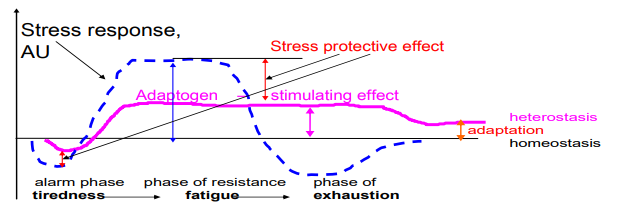
This hypothesis is confirmed, on the one hand, by increased GABA activity after taking Ashwagandha (7). GABA is one of the most important neurotransmitters for “calming” the central nervous system. Furthermore, a reduced release of the stress hormone cortisol was observed in two studies after intake: cortisol concentrations were ~25% lower after taking Ashwagandha in each case (8, 9).
Pain-relieving
An analgesic effect has been studied, among other things, in the context of chronic arthritis (cartilage damage): After 12 weeks of taking 250 mg of ashwagandha, not only was a significantly positive effect on pain perception observed, but also a reduction in swelling in the knee joint (10).
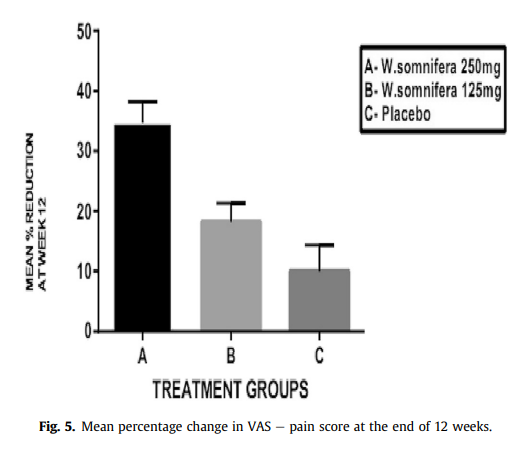
Change in subjective pain perception after 2 weeks of Ashwagandha intake (x)
Also exciting in this context is a study on rats that suffered from severe nerve pain and underwent surgery. Here, the intake of Ashwagandha concentrate led to a significant improvement in the motor apparatus, which was restricted by the pain. The “screams/beeps” caused by the pain also decreased noticeably (10).
Three different dosages were tested in the rats: 30 mg/kg vs. 100 mg/kg vs. 300 mg/kg. At the higher dosages, a greater increase in anti-inflammatory cytokines could be measured. However, there were no differences between the individual dosages regarding the mechanical compensation of the pain. The lowest dosage of 30 mg/kg therefore seems to be sufficient to induce a pain-relieving effect. To what extent this dosage amount can be transferred to humans is currently unclear. This is because if the dosage used in the rat study were converted to the weight of an 80 kg human (30 mg x 80 kg), one would arrive at the very high dose of 2,400 mg/day. For comparison: in most human studies, 300–600 mg per day is administered.
Another interesting finding of the aforementioned study is that a positive effect of Ashwagandha on the pain receptor CCR2 could be observed, thus identifying a possible reason for the observed pain-relieving properties.
Cancer
There are some mechanistic studies that have identified potentially positive effects of Ashwagandha on cancer. However, high-quality human studies are lacking, which is why the following information should be evaluated with great caution.
In cell cultures, improved activity of relevant immune cells was observed, and at the same time, inflammation parameters that are usually negatively influenced by cancer cells were improved (11).
In isolated breast cancer cells, a reduced cell death rate in mitochondria was observed when exposed to proteins extracted from Ashwagandha (12).
Dementia
Potential neuroprotective properties of Ashwagandha were observed as early as the late 1990s. For example, it was observed in isolated cell cultures that Ashwagandha improves lipid peroxidation (LPO); put simply, this involves inflammatory processes in neurons. In addition, increased concentrations of the antioxidant enzymes CAT and GPx were measured in the brains of rats (13). Improved regeneration of damaged synapses was also observed (14).
Cognitive impairments in rats induced by drug administration were attenuated by the intake of Ashwagandha (15). Furthermore, the formation of β-amyloid peptides could be reversed in mice (16). This is a protein structure that, as a precursor of a glycoprotein, can penetrate the brain’s cell membrane and promote plaque formation—and thus Alzheimer’s disease—there (17).
The artificially induced increase in neurotoxins associated with Parkinson’s disease was improved by the intake of Ashwagandha in rats. Motor skills also showed improvement after taking an Ashwagandha concentrate (18).
Sleep
The effects of Ashwagandha on sleep quality have actually been researched relatively thoroughly by now. In some studies, sleep quality was recorded using a subjective scale, while in other studies it was assessed via actigraphy (a measuring device on the wrist). Both methods have good validity compared to the gold standard—polysomnography (19, 20).
In a meta-analysis with 400 subjects, a positive effect on the improvement of sleep quality was measured in all relevant studies (21).
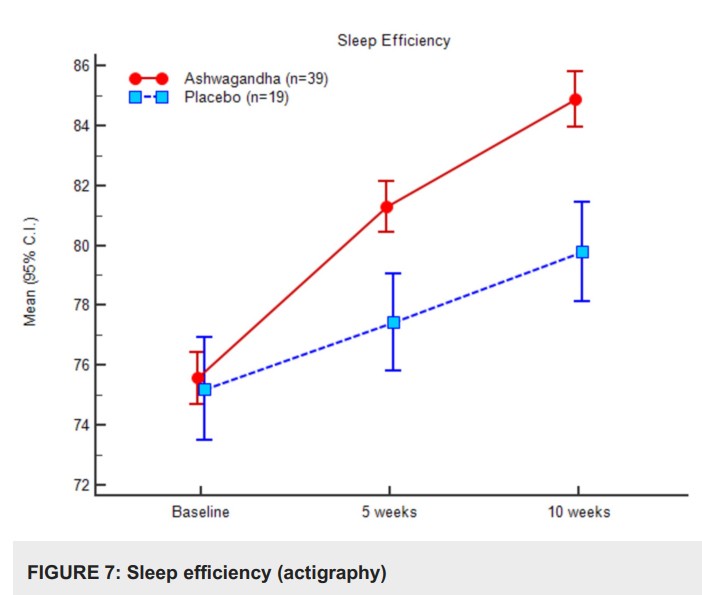
Example of improved sleep quality after Ashwagandha intake – measured with actigraphy (19)
The positive effects on sleep quality are highly likely due to the influence of the neurotransmitter GABA. This has an inhibitory effect on the central nervous system and is associated with improved sleep quality (22).
There is an interesting animal study in which mice were first “artificially” brought into an awake state through caffeine intake, to then observe to what extent Ashwagandha intake positively affects sleep.
In this study, researchers found increased GABA activity after Ashwagandha intake, suggesting a “calming” effect on the central nervous system. Additionally, Ashwagandha also appears to have a positive effect on serotonin receptors, which is also associated with better sleep. This had a positive effect on deep sleep and sleep duration (23).
More important, however, is the following finding from a human study: Ashwagandha has a positive effect on sleep quality in both healthy people and those suffering from chronic sleep problems (24).
Stress Reduction
Many studies have investigated the extent to which taking Ashwagandha has a positive effect on the well-being of people with high chronic stress levels and anxiety. In the vast majority of studies, a positive effect on stress levels and anxiety was found (25, 26, 27). An interaction between the positive effects on sleep quality and the resulting stress reduction is also possible here (28).

Reduced stress perception, measured via PSS (23)
Performance Effects
Endurance
In mice, an increased concentration of red blood cells was demonstrated after Ashwagandha intake (29). In theory, at least, this can lead to improved oxygen transport and corresponding endurance performance. While there are also a few studies on healthy humans that have investigated potential effects on endurance performance, unfortunately, almost all of them have methodological flaws and are of low quality.
For example, Tiwari and colleagues (2021) found improved endurance capacity—measured by changes in VO2max values (30). Choudhary et al. (2015) also found improved endurance capacity after 8 weeks of Ashwagandha supplementation (31). However, the VO2max value in the study was not determined during a standard test with increasing intensity on an ergometer, but during a 20 m shuttle run. Here, too, it is questionable how meaningful the results are.
There is also a study on well-trained cyclists in which a positive effect on VO2max and “time-to-exhaustion” on an ergometer was found after 8 weeks of Ashwagandha intake (500 mg/day) (32). However, the study lacks many important details regarding training, the performance test, and nutrition, which makes a comprehensive evaluation of the study difficult.
In a higher-quality study, however, no effect of 500 mg of Ashwagandha per day on a 7.5 km time-trial performance on a cycle ergometer could be found (33).

Strength
To our knowledge, there are only 2 studies that have investigated possible effects on strength performance:
In one of the better studies in this area, a slightly positive effect on 1-RM strength performance in the bench press and squat was observed after 12 weeks of daily Ashwagandha intake (500 mg) (34).

Change in 1-RM squat after 12 weeks of Ashwagandha intake (34)
The second study is similar in structure, and here too, a slightly positive effect on 1-RM strength performance in the bench press was found (35). In addition, a slight increase in testosterone levels and improvement in muscle building in the arms were observed. In contrast, no change was observed in chest circumference or leg circumference.
Compared to the studies in the endurance field, the intervention studies in the strength field are of significantly higher quality. However, it should be noted that the subjects were not advanced athletes, and it is therefore unclear how Ashwagandha affects better-trained athletes.
Recovery
Improved recovery is one of the most frequently mentioned benefits for athletes. Naturally, it stands to reason that the previously mentioned benefits for sleep quality and the reduction of the stress hormone cortisol would also have a positive effect on the recovery of the central nervous system in athletes. However, we do not know this without corresponding investigations. Furthermore, there are shockingly few studies that address potential effects on recovery.
In combination with strength training, Ashwagandha intake led to slightly improved CK values, which is sometimes used as a biomarker for muscle damage (36). However, it is unclear whether muscle soreness was actually reduced by the intake.
In a study with healthy young men, an improvement in subjective recovery in connection with endurance sports was found. In addition, an improvement in markers for oxidative stress was observed (37). This sounds very promising at first, but unfortunately, important information on training and nutrition is missing here to be able to evaluate the intervention in detail.
Side Effects
Besides all the hype about the potential benefits of Ashwagandha, one should also always inform themselves about health risks.
Documented side effects include nausea, abdominal pain, or diarrhea (38). However, these occur rather rarely at the usual dosages of 300–600 mg and are not overly severe (39).
However, there are also isolated reports of liver failure (40, 41). If Ashwagandha really increased the risk of liver failure, that would obviously be a very high health risk. Unfortunately, the exact dosage of Ashwagandha is not mentioned in the reports cited, and the patients sometimes also take other dietary supplements, making an accurate risk assessment difficult. It also cannot be ruled out that the liver problems were caused by other factors and that the patients happened to be taking Ashwagandha as well. Controlled placebo studies have at least so far not found any negative effects on organ health (42).
We do not want to downplay the risks. Monitoring liver values is definitely recommended, and intake is strongly advised against in cases of pre-existing liver problems. Because the risk of potential side effects is currently not entirely clear, intake is advised against during pregnancy and for breastfeeding mothers (43).
Conclusion and Evaluation
- Ashwagandha does indeed exhibit several health-promoting properties: the stress-relieving effect and positive influence on sleep quality should be particularly highlighted.
- It may also have a positive effect on dementia, although high-quality human studies confirming previous observations in mice are lacking.
- There are some indications that Ashwagandha could have a positive effect on endurance performance, but more high-quality studies are needed to conclusively evaluate this effect.
- The same can be said for potential benefits in strength sports: two studies are simply not enough to assess the effect well.
- While it is fundamentally possible that athletes would benefit from the stress-reducing effect, a direct correlation has not yet been investigated.
- Ashwagandha is suspected of having a negative effect on liver health. However, this assumption is based on documented individual cases. Unfortunately, larger-scale studies investigating the safety of Ashwagandha do not currently exist.

0 Comments