


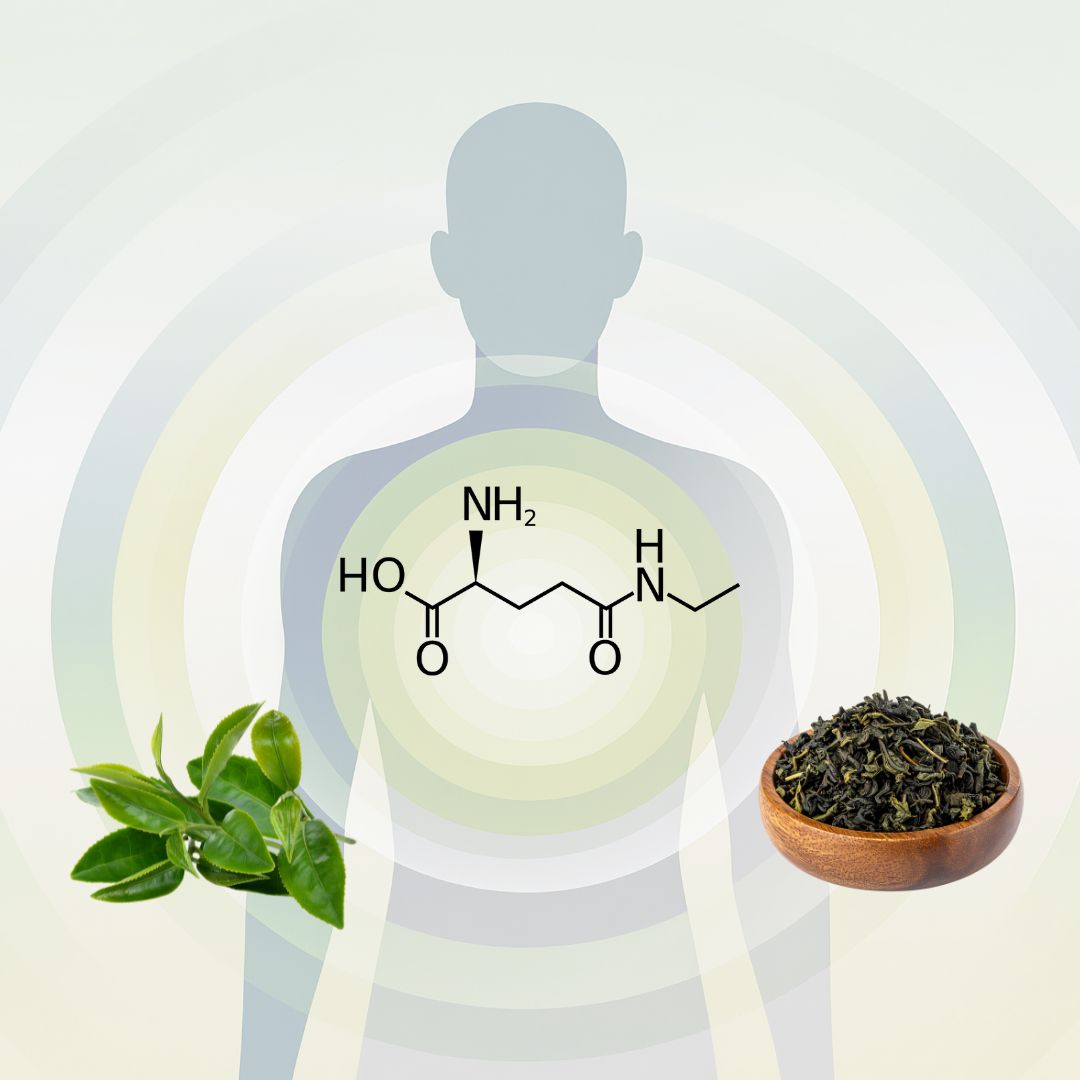

An unusual amino acid with neurocognitive potential
L-Theanine is a non-proteinogenic amino acid that does not contribute to the formation of body proteins but acts primarily within the central nervous system. In recent years, it has attracted growing research interest for its potential effects on cognitive performance.
The amino acid is found almost exclusively in the leaves of the tea plant (Camellia sinensis), particularly in green tea. It is associated with a characteristic mental state that many people report after drinking tea: alert, focused, and calm—without the nervousness or overstimulation often experienced after coffee. This effect has attracted the interest of neuroscientists, as studies show that L-theanine has measurable effects on neuronal activity, stress responses, and cognitive stability
As a result, interest in competitive sports is increasing as well, since mental factors such as attention, stress regulation, and decision-making quality play a key role in performance.
Physiological properties and mechanisms of action of L-Theanine
A key factor underlying its effects is its ability to cross the blood–brain barrier. Pharmacokinetic studies indicate that L-theanine is actively transported into the brain and directly influences neuronal systems (1).
L-theanine’s effects are partly explained by its structural similarity to glutamate, the brain’s primary excitatory neurotransmitter involved in more than 80% of synaptic transmissions. Excessive glutamatergic activity, however, can promote neuronal hyperexcitability, stress, and cognitive instability.
L-theanine binds to various glutamate receptors, including NMDA, AMPA, and kainate receptors, but with significantly lower agonistic activity than glutamate itself. As a result, it does not exert a blocking effect but instead acts as a modulator (2). The result of this modulation is not a shutdown of neuronal activity, but a dampening of excessive excitatory signaling. This helps stabilize neuronal communication without reducing wakefulness or performance. The mechanism is particularly relevant under conditions of stress or strain, where overactivation of the central nervous system can impair performance (3) – an effect some people experience as “overstimulation” after consuming caffeine.
Beyond its effects on the glutamatergic system, L-theanine also affects other neurotransmitter pathways. Animal experiments suggest an influence on GABA signaling, which may contribute to its calming effects (4).
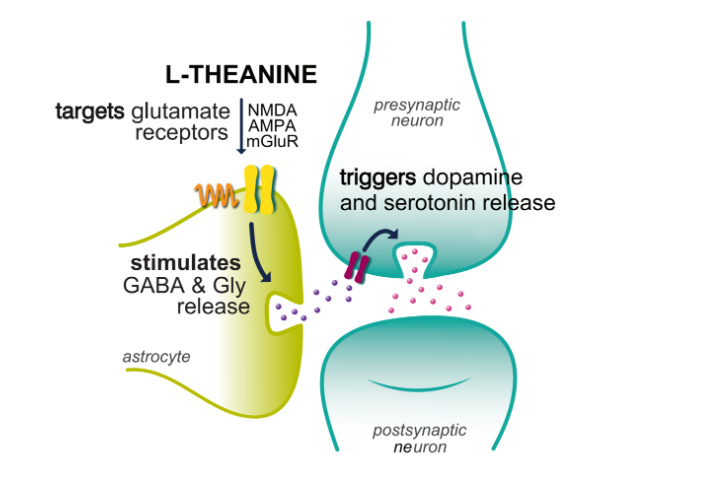
One of the most consistently replicated effects of L-theanine involves brainwave activity. Multiple EEG studies have demonstrated a significant increase in alpha-wave activity (8–13 Hz), particularly in the frontal cortex. Alpha waves are associated with a state of relaxed yet alert attention—a mental state commonly observed during meditation, flow states, or periods of highly focused activity (4,5).
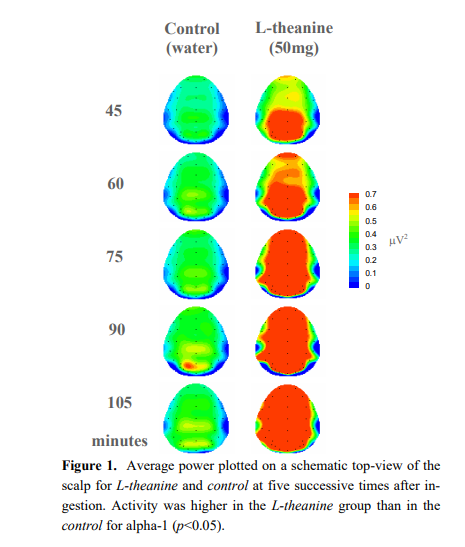
L-theanine has also been associated with changes in dopamine and serotonin availability in brain regions linked to motivation, mood, and reward (7).
Summary of the mechanisms of action:
- Modulating glutamate receptors
- Modulating neurotransmitter GABA
- Dopamine and serotonin release
- Activation of alpha waves
Natural Occurrence and Dosage
L-theanine is found almost exclusively in tea leaves. Particularly high concentrations occur in green tea, especially in shaded varieties such as Gyokuro or Matcha. However, the L-theanine content varies widely depending on the tea variety, cultivation conditions, harvest time, and processing methods (8).
However, reaching performance-relevant doses through food and beverages alone is challenging, as one litre of green tea typically provides only about 60–90 mg of L-theanine. (9). In order to reach the amounts of 50-200 mg of L-Theanine frequently used in studies, one would have to drink a relatively large amount of green tea.
Anecdotal observations from self-experiments and our coaching practice suggest that even 250–500 ml of green tea may have positive effects on concentration.
L-Theanine and cognitive performance in non-athletes
Much of the evidence on L-theanine comes from studies in non-athletes. Nevertheless, these findings are valuable for understanding its fundamental effects on cognitive domains such as attention, working memory, stress processing, and mental fatigue. Several randomized, placebo-controlled studies have shown that L-theanine can improve attentional stability under cognitive load. In this context, the combination of L-theanine with caffeine has been particularly well studied:
- In the study by Haskell et al. (2008), L-theanine was shown to reduce the typical nervousness of caffeine, while maintaining the attention-enhancing effects (10)
- Comparable results were reported by Giesbrecht et al., showing that the combined intake of L-theanine and caffeine enhanced accuracy and attention switching in cognitive tasks (11)
In another relevant study (12), investigated the individual and potentially synergistic effects of caffeine and L-theanine in more detail, using the following groups:
- L-theanine 250 mg
- Caffeine 150 mg
- L-theanine 250 mg + caffeine 150 mg
- Placebo
The effects of each intervention group were then examined with respect to attention (digit vigilance, Rapid Visual Information Processing [RVIP]), working memory, reaction time, serial sevens (serial subtraction of sevens), as well as self-reported mood, fatigue, and headache occurrence.
| Condition | Cognitive & mood-related effects (vs. placebo) |
|---|---|
| L-Theanine alone | • Increased headache ratings • Worse performance on “Serial Sevens” (fewer correct answers) • No general cognitive benefits |
| Caffeine alone | • Faster reaction time (Digit Vigilance Test) • Higher accuracy on the RVIP test • Lower increase in mental fatigue |
| L-Theanine + Caffeine | • Improved RVIP accuracy • Reduced mental fatigue • Faster simple reaction time • Faster reaction time in numerical working memory • Better sentence verification accuracy • Fewer headaches and fatigue • Higher alertness ratings • Positive interaction effect in delayed word recognition |
Overall, the results suggest that L-theanine exerts its primary effects in combination with caffeine. A recent meta-analysis of 15 randomized controlled trials found a small to moderate overall effect on attention, stress, and mood. (13).
Interestingly, L-theanine appears to improve accuracy more than reaction speed, primarily by reducing error rates.
However, objective physiological changes do not always translate into subjective experience; for example, Dodd et al. found reduced cortisol levels without changes in perceived stress.(11).
Importance of cognitive performance in sports
Attention, anticipation, decision-making quality, and stress regulation are key performance factors in almost all sports. Therefore, its use in competitive sports has garnered increasing interest in recent years. It is hoped that the use of L-theanine (or in combination with caffeine) will reduce technical errors, mitigate a slowed reaction, and improve overall mental stability. Previous studies have therefore primarily focused on precision- and skill-based sports.
One of the earliest sport-related studies examined the effects of L-theanine on central nervous system recovery following intense stress. Although no differences in performance parameters were observed, a significant increase in alpha-wave activity was detected, indicating enhanced neuronal recover (12).
- In curling athletes, an RCT found that the combination of L-theanine and caffeine improved sport-specific performance compared with placebo and L-theanine alone (13)
- In 18 archers (College USA), the intake of L-Theanine (no information on the dose) significantly reduced nervousness before a competition (14)
- In elite Iranian wrestlers, a recent study found that the combination of caffeine and L-theanine improved cognitive performance, strength, and sport-specific performance parameters (15)
- oxidative stress, muscle activation and regeneration, based on pre-clinical data
| Study | Participants | Intervention | Test parameters | Key results |
|---|---|---|---|---|
| Zaragoza et al., 2019 | College Athletes n = 12 |
L-Theanine (50 mg, 200 mg) vs. Placebo | • EEG (Alpha activity) • HR, performance • Recovery after intense stress |
• ↑ Alpha waves after stress • = No change in physical performance • ↑Indication of improved neuronal recovery |
| Yilmaz et al., 2023 | Competitive Curling Athletes n = 20 |
• L-Theanine • L-Theanine + Caffeine • Placebo |
• Sport-specific precision tests • Cognitive stress tests |
• Best performance with L-Theanine + Caffeine • ↑ Precision under fatigue • L-Theanine alone: minor effects |
| Lim (2024) | Archers n = 18 |
• L-Theanine vs. Placebo | • Cortisol levels • ↑ Subjective stress scores |
• ↓Reduced cortisol levels with L-Theanine • ↓Reduced subjective stress perception |
| Razazan et al., 2025 | Elite Wrestlers n = 30 |
• Caffeine • Caffeine + L-Theanine • Placebo |
• Stroop test • Vertical jump • Wall ball test • Grip strength • Wrestler-specific throwing tests |
• Combination superior in cognitive & physical tests • ↓ Errors under fatigue • ↑ Wrestling specific performance |
Practical classification, dosage and safety
Most studies have used doses of 50–200 mg of L-theanine, often in combination with 50–200 mg of caffeine, administered approximately 30–60 minutes before exercise. Higher doses have not yet demonstrated a clear additional benefit
Overall, L-theanine is considered to be very well tolerated. No relevant side effects occurred in the analyzed studies. Only in the study by Haskell et al. (2008), headaches occurred more frequently after taking 250 mg of L-theanine (12).
Summary and classification of the evidence for practice
- L-theanine is not a typical performance enhancer; instead of maximizing activation, it acts by stabilizing central nervous system activity
- Promising results of L-theanine + caffeine on cognitive performance outside of sports
- Research on athletes is limited & sample sizes are often small, but previous results are promising
- within a solid nutritional foundation, it may be considered a scientifically plausible tool as part of a holistic performance approach—particularly when issues such as nervousness persist

0 Comments