




Why Fat Loss Works Differently for Athletes
Fat loss and athletic performance — at first glance, a classic conflict of goals. Reducing calories risks muscle mass, training quality, and in the worst case, competition form.
The good news: With the right strategy, fat loss and performance can indeed be reconciled.
However, athletes need somewhat different rules: Simply reducing calories doesn’t work and quickly leads to performance declines and loss of muscle mass.
In this article, we explain the most important rules for sustainable fat reduction as an athlete:
- Learn the 4 most important rules
- Concrete practical tips on where you should really save calories (and where not)
- A scientifically validated hierarchy of measures
- Answers to the most common questions and myths about cutting
All recommendations are supported by current studies and linked directly in the article 🔗

1. The Fundamentals: Energy Balance and Monitoring
Energy Balance — The Basics
Fat loss works through a calorie deficit. Period. Regardless of diet form — whether low carb, IF, carnivore, keto — in the end, everything stands or falls with energy balance: You must consume less energy than you expend.
This has been extensively investigated and documented in studies:
- Intermittent fasting is not more effective than continuous calorie reduction when the average calories are identical (1)
- An analysis of 32 high-quality studies found: Fewer carbohydrates do NOT lead to increased fat loss when calorie and protein amounts are identical (2)
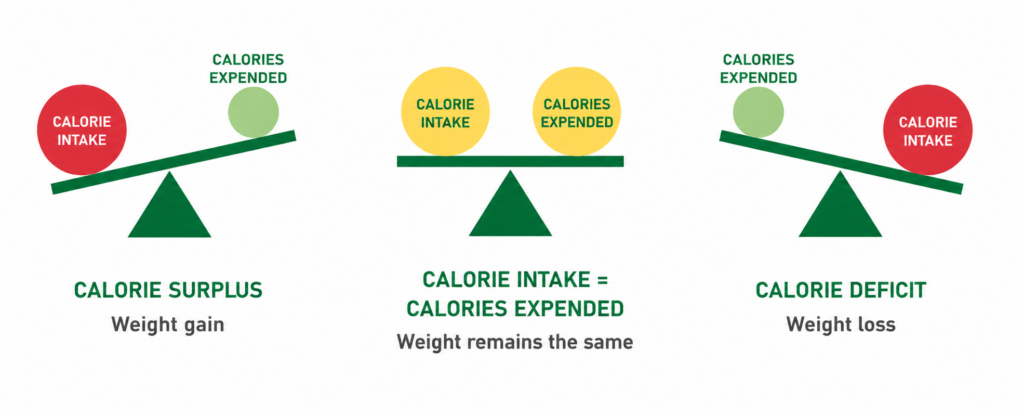
What many overlook: Energy balance is the framework, but not the whole story. How you implement the deficit determines whether you lose fat or muscle mass and whether your performance collapses or remains stable even during a cut.
As an athlete, it’s not enough to simply eat less – when and how you eat is more critical here than in a typical office job. The keyword is periodization:
Calories and carbohydrates are adjusted to your training plan, not the other way around.
Those who train hard need adequate energy and carbs around training even during a cut – the details follow below. Here’s a rough overview first:
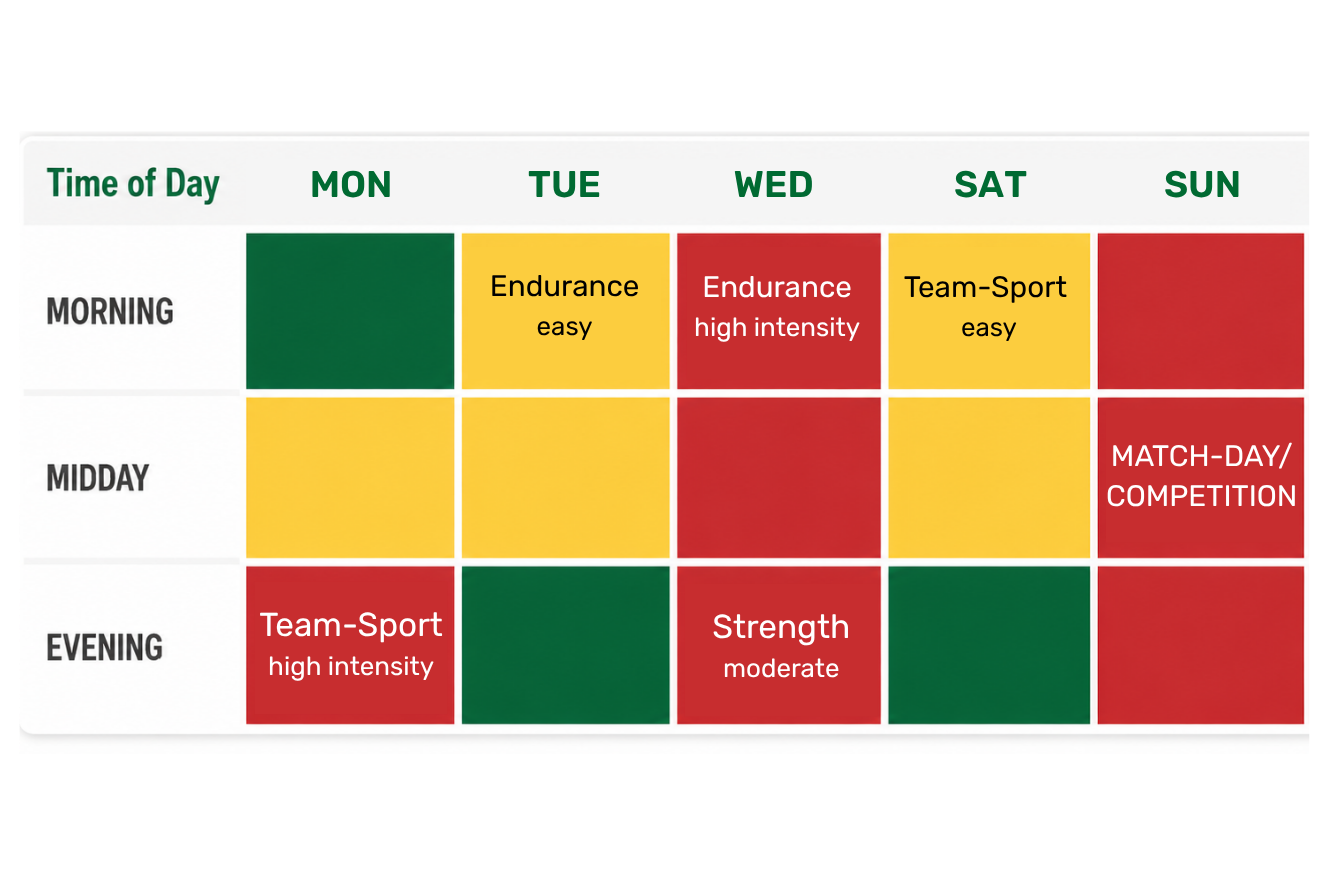
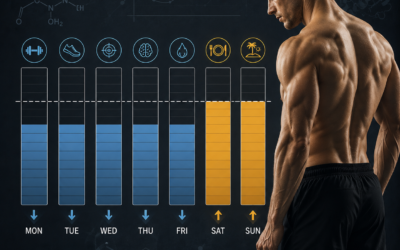
green: low load/large time gap from training – few calories and carbs
yellow: moderate load/moderate time gap from training – moderate amount of calories and carbs
red: high load/small time gap from training – high amount of calories and carbs
Why Proper Monitoring Matters
The scale alone lies – even more so for athletes than others. Water retention from training, salt, stress, sleep deprivation, or the menstrual cycle can shift weight overnight by 1–2 kg and therefore completely obscure actual fat loss when weighing. Every gram of glycogen binds 3–4 g of water (3) — after a refeed day with more carbohydrates, you can easily weigh +1–2 kg more without having gained a gram of fat. Add to this sweat losses of more than 1.5 L/h during intense training (4): Those who step on the scale directly after training are measuring water loss – not fat loss. For female athletes, the luteal phase additionally shifts total body water upward (5). Those who only look at daily weight risk unnecessary and counterproductive adjustments.
Better monitoring combines multiple data points:
- Weekly average weight instead of daily values (always in the morning, fasted, after using the bathroom)
- Circumference measurements at the waist, hips, thighs, and chest
- Performance data from training, subjective assessment of energy levels & exertion
- Optional: Skinfold measurement or DEXA for more detailed body composition analysis
Only the combination shows the true picture.
2. The 4 Levers for Fat Loss as an Athlete
Athletes who lose fat while maintaining muscle mass and performance usually get four things right — no magic diet, no supplement stack, just four proven basics that consistently work in practice.
2.1 Increase Protein Intake
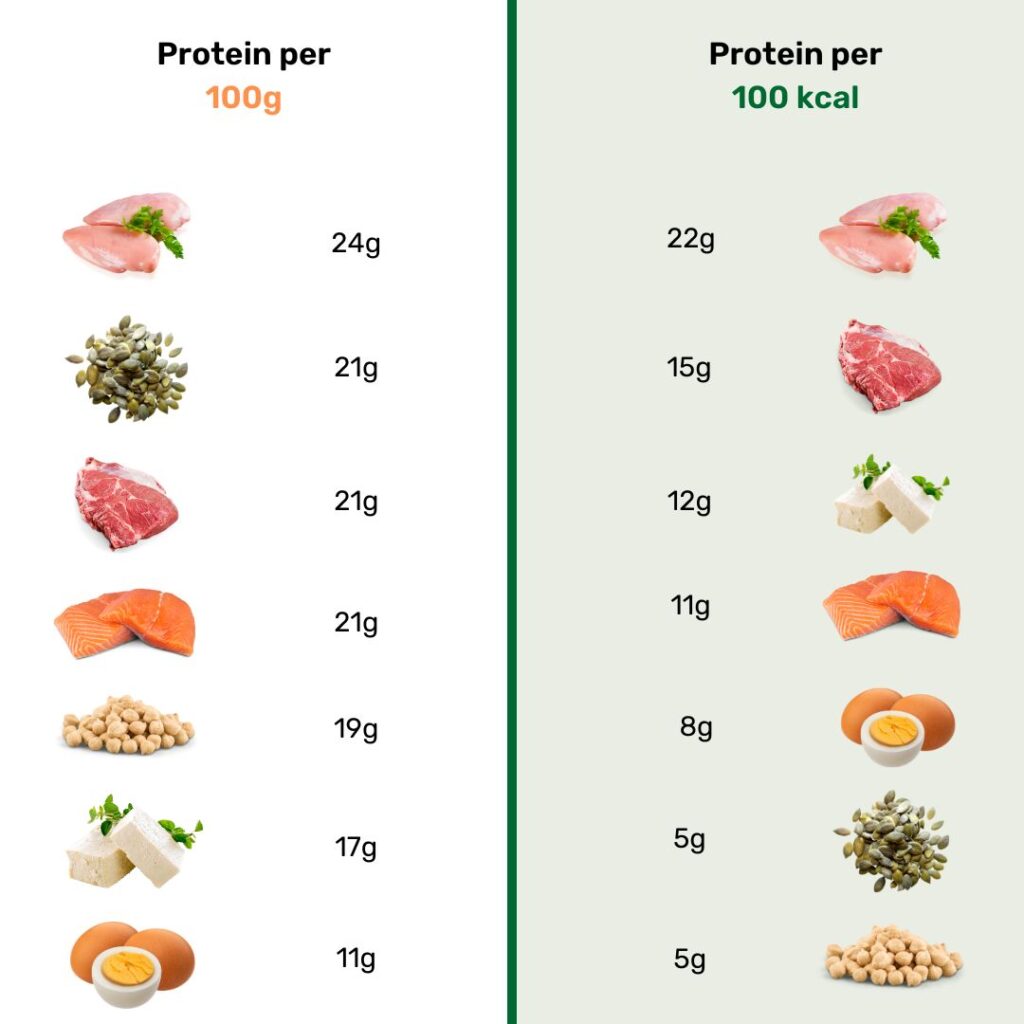
Protein is the most important macronutrient during a fat-loss phase: it helps preserve muscle mass, keeps you full for longer, and has the highest thermic effect of all macronutrients. Around 20–30% of protein calories are used just for digestion and metabolism, compared to roughly 5–10% for carbohydrates and only 0–3% for fat (6,7).
Specific recommendation for athletes in a deficit:
- 2.0–2.2 g protein per kg target weight (not your current weight)
- Distribution across 3–5 meals with approximately ~0.4 g of protein/kg body weight at each meal
- Prefer high-quality sources after training: protein powder, lean meat, fish, eggs, low-fat quark, skyr, cottage cheese, tofy, tempeh
- Vegane Proteinquellen sind grundsätzlich ebenso geeignet – sie enthalten jedoch weniger Leucin, die wichtigste Aminosäure für die Muskelproteinsynthese (8)
- Simple solution: choose slightly larger protein portions to compensate for the lower leucine density
- Important: this mainly applies to the post-workout meal. Over the rest of the day, total protein intake matters far more than the exact amino acid profile of individual meals.
📊 Study: Longland et al. 2016 (9) | 4 weeks | calorie deficit | same training
- 1.2 g/kg protein: −3.5 kg fat | muscle mass: stagnated
- 2.4 g/kg protein: −4.8 kg fat | muscle mass: +1.2 kg
A meta-analysis — meaning an evaluation of many similar studies on the same topic — identified 1.6–2.2 g of protein per kg of body weight as the evidence-based sweet spot for trained individuals (10).
2.2 Calorie Deficit – Where You Should Save Calories
This is one of the most important points — and at the same time one of the most commonly overlooked:
Calories around training are not the place to cut back — this is where you fuel performance, not save calories. Before, during (for longer sessions), and after training, your body should have enough energy and nutrients available. That means proper meals around training and extra Intra-Workout-Carbs during long endurance sessions.
This is what maintains training quality, supports recovery, and preserves the training stimulus needed to hold on to muscle mass during a cut. Cutting calories here often does more harm than good.
Instead, save calories during the parts of the day that are further away from your training sessions:
- Breakfast, when no training is scheduled in the morning
- Office snacks throughout the day (often the largest hidden calorie source)
- Late dinner after early training completion
- On Rest days generally reduced carb and calorie intake
So wouldn’t it make sense to eat carbs only before training and skip them afterward?
No — quite the opposite. Training increases muscle insulin sensitivity for several hours, meaning your muscles become especially efficient at absorbing and storing carbohydrates after exercise (11). In practice, this means that carbs consumed post-workout are preferentially stored as glycogen in the muscles rather than as body fat. Especially during a fat-loss phase, it therefore makes sense to place a large portion of your available carbohydrates in the post-workout meal.

Keep the Deficit Moderate
One of the most common mistakes athletes make is creating too large of a calorie deficit. Aggressive crash diets quickly lead to muscle loss, reduced performance, and, in many cases, poor long-term adherence after only a few weeks.
Recommendation: set the deficit relative to maintenance calories, not as a fixed calorie number.
Why? Because the same deficit can have completely different effects depending on the person. For a 60 kg female athlete, a 500 kcal deficit may already represent 20–25% of daily energy needs — aggressive enough to increase hunger, impair recovery, and potentially affect hormonal health over time. For a larger, highly active male athlete with high training volume, the exact same 500 kcal deficit might only represent around 5% of maintenance intake and barely move the scale. In other words: a calorie deficit should always be proportional to the athlete, their body size, and their training load and hence their specific calorie requirements — not copied as a universal number.
- Moderate Cut: ~15% below your maintenance calories
- Aggressive cut: Generally not recommended, as it can lead to muscle breakdown and performance impairments (12)
- Planning matters: with the right strategy, even shorter phases with a more aggressive deficit (20–25%) can work well — the key is knowing how to implement them properly.
For an 80 kg athlete with maintenance needs of around 3,000 kcal, a 10–15% deficit equals roughly 300–450 kcal per day. Over the course of a week, that adds up to about 2,100–3,150 kcal — enough to lose roughly 0.5–1 kg of fat every 2–3 weeks without unnecessarily risking muscle mass. Since 1 kg of body fat corresponds roughly to 7,700 kcal (13), this represents a moderate but sustainable rate of fat loss.
The exact deficit that works best for you depends on several factors — including your sport, training volume, lifestyle, stress levels, sleep quality, and previous dieting history.
This is precisely where our coaching at athlEATcoach comes in: individual calculation, data-based adjustment over weeks — adapted to your daily life, your preferences and your training.
For Long Diet Phases: Refeeds and Diet Breaks
After 8–12 weeks in a calorie deficit, many athletes notice that progress starts to slow down. Hunger increases, training feels harder, and energy levels drop. That’s not just in your head — the body actively adapts by becoming more energy-efficient, a process known as metabolic adaptation (14).

2.3 Prioritize Strength Training
During a calorie deficit, strength training provides the key signal that tells the body: “This muscle is still needed, don’t break it down.” Cardio alone is much less effective in this regard, which is why even endurance athletes benefit from including some strength training during a fat-loss phase.
Three Non-Negotiable Points for Training
- Train progressively: try to maintain or slightly improve weights, repetitions, or training volume over time. This principle is known as progressive overload. It’s naturally more challenging during a calorie deficit than during a muscle-building phase, but still achievable. Simply “getting through workouts” during a cut often means missing the most important stimulus for maintaining muscle mass.
- Monitoring: Track your training performance consistently. Whether you use a training log, an app, or a simple Excel sheet does not matter. What matters is having objective feedback on your performance.
Think of training performance as an early warning system. If strength, volume, or overall performance noticeably declines over 1–2 weeks, the calorie deficit is often too aggressive or recovery is insufficient. - Nutrition after training: Directly after hard sessions, you need protein for muscle protein synthesis and carbs for glycogen resynthesis. Especially during a cut, this is the critical time for intake of these two macronutrients.

2.4 Sleep — The Underestimated Lever
Fat loss and athletic performance — at first glance, a classic conflict of goals.
Poor sleep is one of the most underestimated factors during a fat-loss phase, and not just because it makes you tired. Sleep deprivation lowers levels of the satiety hormone leptin while increasing levels of the hunger hormone ghrelin, creating the perfect setup for stronger cravings and higher calorie intakem (15).
Specifically: Just three nights with only 5 hours of sleep increased ghrelin levels, preference for sweet foods, and total calorie intake significantly (16). Those who sleep too little at night therefore struggle during the day with a hormonal system that actively demands high-calorie foods – and precisely when discipline is already required during a cut.
Additionally: Subjects in a calorie deficit with only 5.5 hours of sleep lost merely 25% of their weight from fat mass – with 8.5 hours of sleep, this proportion rose to 56% (17). Sleep is therefore not a recovery measure on the side – it is a central lever for successful fat loss.
Practical tips:
- 7–9 hours as a target window – with high training intensity, rather 8–9 hours
- Consistent sleep times, even on weekends
- Before sleep: reduce screen time, keep room cool and dark
- Especially attentive during a cut: hunger hormones (leptin, ghrelin) react sensitively to sleep deprivation — cravings are often sleep deprivation in disguise
3. Practical Tips: Where Calories Are Really Saved
Theory aside – in the end, you must concretely consume fewer calories in daily life. With these simple practical tips, you can save calories easily but effectively.
3.1 Identify Hidden Calories
Most athletes underestimate their calorie intake by 200–500 kcal per day – that’s the difference between “diet works” and “diet has stagnated for weeks”.
The main suspects:
- Oils and fats: 1–2 tbsp olive oil dressing or mayo quickly equals 100–200 kcal. And often the oil is simply poured into the pan with an open lid – without portioning it.
- Liquid calories: Juices, smoothies, latte with milk – all of this barely satiates but can quickly add up to several hundred calories per day.
- “Healthy” snacks: Nuts, dried fruits, granola bars, nut butter – all healthy, but healthy ≠ low-calorie.
- Unnoticed snacking: Many consume significantly more calories without noticing. A cookie here, a cracker there, and everything unnoticed while watching TV or working on the side. Eat at fixed times and not while doing something else.
Practical tip: Log everything you eat and drink for a week – really everything, including sauces, dressings, and tastings while cooking. Most are surprised by what adds up.
3.2 Reduce Fats and Oils — Without Losing Flavor
Fat provides 9 kcal/g, more than twice as many calories as protein or carbs. This is where the largest “silent” savings potential lies.
- Pan: Spray oil instead of pouring from the bottle. 1 tbsp oil = 90–100 kcal that you don’t even “feel” when sautéing.
- Switch cooking methods: Frying → baking, steaming, grilling, air fryer. Often saves 200–400 kcal per meal in total.
- Cheese, cream, mayo: Light versions or smaller amounts, but more intense varieties (aged Parmesan instead of young Gouda).
- Salad dressings: no ready-made dressings – better homemade yogurt- or vinegar-based dressings. This quickly saves 150–250 kcal per salad.
- Beware of “fitness”-marketed products: Granola, protein bars, nut bars, “healthy” mueslis are often very high in fat. Check the label: > 15 g fat per 100 g is a warning sign.
3.3 Maximize Satiety per Calorie
This is the underestimated master discipline: choosing foods that provide high volume and satiety per calorie. Those who are full have no adherence problems.
Satiety champions (18):
- High in fiber: Vegetables, berries, legumes, oats, chia and flax seeds (let swell in water)
- Volume + water: Soups, stews, salad as an appetizer, potatoes – mechanically fills the stomach
- Lean protein: Chicken breast, low-fat quark, skyr, cottage cheese, white fish, egg whites – high satiety per calorie
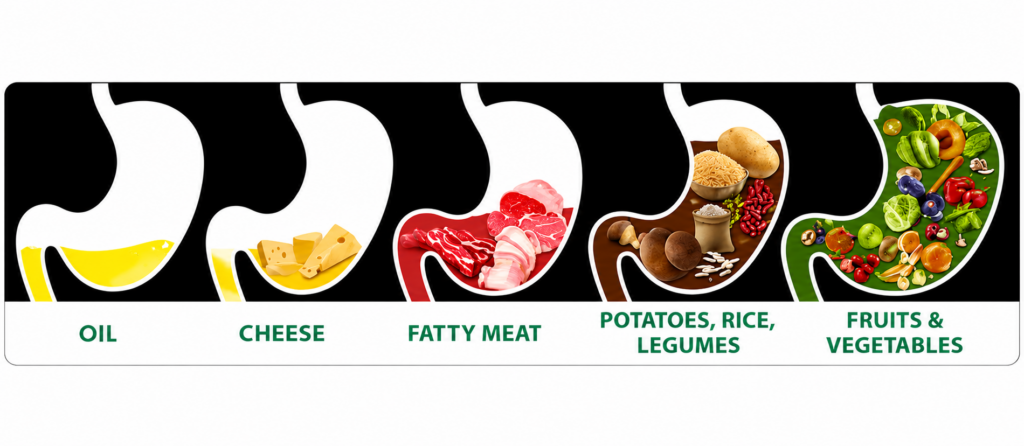
With slight adjustments to main meals, you can easily save large amounts of calories – without having to go hungry.
Rule of thumb for every main meal:
1/3 of the plate protein source + 1/2 vegetables + 1/3 satiating carbohydrate source (potato, legumes, whole grain product)
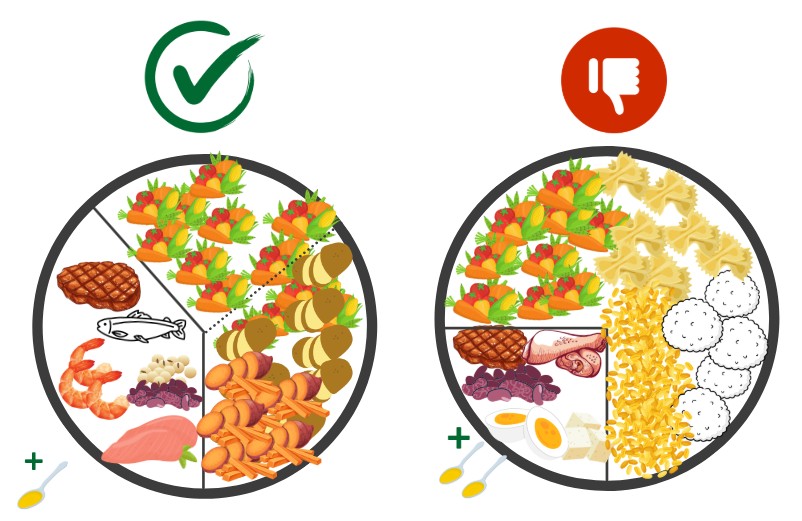
Additional Info: This is, of course, just an example – the optimal distribution might look slightly different in your case.
3.4 When to Save Calories — and When Not
This is the part that 90% of diet tips on the internet leave out. Athletes who intelligently time their calories have a massive advantage.
Save here:
- Rest days: lower energy demand, lower carb necessity
- Easy training: mobility, cardio Z2, technique
- Evening after early training completion: e.g., training at 4 PM – recovery meal but then only small dinner
- Rest day with no or little exercise
Don’t save – fuel up:
- Around hard training (pre, intra, post)
- Competition days
- Long sessions (> 120 min)
- Strength days with high volume
Carb and calorie cycling is a practical tool here: higher intake on hard training days, lower on rest days. The weekly balance remains the same – but performance on critical days is significantly better.
4. Tracking — Is It Really Necessary?
The honest answer: No, you don’t have to track forever. But, it’s very useful at the beginning.
Tracking is primarily a learning tool. Those who track cleanly for 2-6 weeks develop a realistic sense of portion sizes, calorie densities, and their own macro distribution. The knowledge remains – even when you no longer use the apps.
What tracking gives you:
- Realistic picture of actual intake (not perceived)
- Identification of hidden calorie sources
- Sense of 30 g protein, 50 g carbs, 10 g fat from memory
- Data basis for adjustments when the diet stagnates
When tracking does more harm than good:
- With a history of disordered eating (here a coach or therapist is the better path)
- When tracking itself becomes an obsession
- When meals are extremely consistent and you already know your setup in your sleep
For most athletes: track for 2–8 weeks, then deliberately let go – and only reactivate during stagnating phases or before important competition preparations.
5. FAQ & Myth Check
“Carbs in the evening make you fat” — Myth
False. What counts is the daily balance, not the time of day. Well-controlled studies (19) showed that carbs in the evening can even have advantages for satiety and hormones. For athletes with evening training, carbs after 6 PM are therefore not counterproductive, but can even offer benefits – especially when training in the evening.
“Fasted cardio burns more fat”
Yes, acutely during exercise, but not over 24 hours. This is exactly what researchers (20) found in a controlled study: Participants completed cardio 3 times a week for 4 weeks – one group on an empty stomach in the morning and the other group in the evening after a meal. Energy intake and macronutrient distribution were identical. The result: Both groups lost the same amount of body fat. The only difference is that the fasted cardio group lost more fat in the morning, and the other group lost it in the evening.
“How fast can I lose weight without losing muscle?”
Rule of thumb: 0.5–0.7% body weight per week. For an 80-kg athlete, that’s 400–560 g per week. More is possible, but the risk of muscle and performance losses increases sharply.
“I’m in a calorie deficit, why am I not losing weight?”
Answer number 1:
Perhaps something is already happening – just not visibly on the scale. Body weight often fluctuates by 1–2 kg daily, mainly due to water, glycogen, and gut content – not fat mass (21). Short-term weight changes therefore say little about actual fat loss. During a cut, waist circumference, photos, and training performance are often much more indicative than daily weight.
Answer number 2:
All calorie calculations are based on average values – your personal needs may actually be lower. Validation studies show that formulas for calculating basal metabolic rate can deviate from the actual value by 314 to 445 kcal per day. And this doesn’t even include the estimation of calorie expenditure during exercise (22). If nothing changes in your waist circumference after 2 to 3 weeks, you should reduce your calorie intake by approximately 150 to 250 kcal and closely monitor any changes. Small adjustments are better here than a large cut – this way, training quality and satiety are maintained for as long as possible.
“Which supplements are really worthwhile?”
These three have solid evidence for athletes during a cut:
- Caffeine: Improves training performance and pain perception (23), suppresses hunger (Caution! Caffeine is metabolized very slowly and can still affect sleep quality up to 6 hours after intake (24))
- Creatine: Continue dosing even during a cut (3-5 g/day), protects performance and muscle mass (25)
- Protein powder: Practical for reaching your protein target during a deficit
Everything else is optional to a waste of money. Vitamin D for proven deficiency, Omega-3, and possibly magnesium as a basic supplement can be useful, but have no influence on fat loss.
“My performance is declining — is that normal?”
A small performance drop after several weeks of dieting is normal – especially for high-intensity sessions. It’s a warning sign if:
- You perform poorly in all training sessions
- You’re tired and exhausted around the clock
- Sleep deteriorates
- Mood, libido, motivation drop
- Susceptibility to colds increases
Then: Reduce deficit, take a diet break, or end the cut.
6. Take-Home: The Hierarchy for Fat Loss as an Athlete
These are the 5 most important aspects for the goal of fat loss as an athlete:
- Moderate deficit: ~15% below maintenance needs, ~0.5–0.7% weight loss/week
- Time calories intelligently: save further from training, more calories and carbs around training
- High protein: 2.0–2.2 g/kg target weight, distributed across 3–5 meals
- Prioritize strength training: 2 strength training sessions per week are mandatory. Record weights and repetitions and try to continue increasing your performance
- Sleep 7–9 h: non-negotiable during a cut
Everything else is fine-tuning and should be left to the professionals.
7. Coaching: Your Individual Roadmap
Theory is one thing, individual implementation in your sport, with your training plan and your daily life is another. This is precisely where we come in at athlEATcoach: data-based coaching for athletes who want fat loss and performance simultaneously.


0 Comments