


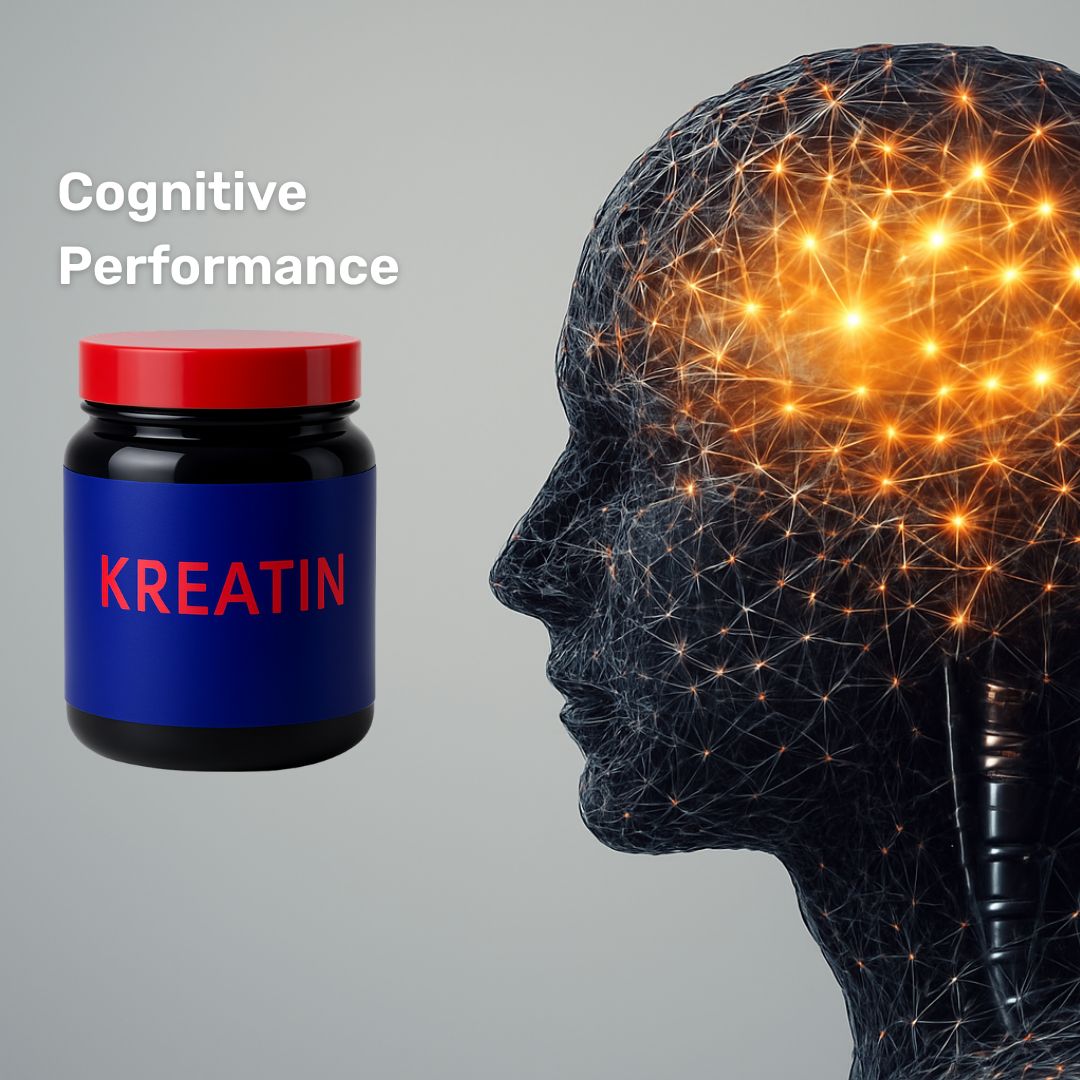

Creatine monohydrate is one of the most thoroughly researched supplements available. Hundreds of studies have confirmed its ability to support strength, muscle development, and exercise performance. But a growing body of research suggests its benefits extend beyond muscle — with increasing attention on its role in brain function and neurological health.
The rationale is biologically plausible: creatine is essential for maintaining cellular energy balance and is actively involved in energy metabolism within the central nervous system.
This raises an important question: can creatine enhance not only physical performance, but cognitive performance as well?
Creatine Metabolism in the Brain
The brain is one of the body’s most energy-demanding organs. Despite accounting for only around 2% of total body weight, it consumes roughly 20% of the body’s energy at rest (1). This is not a minor observation—it highlights the brain’s uniquely high metabolic demands.
And this is exactly where creatine comes in.
The creatine kinase–phosphocreatine (CK/PCr) system acts as the brain’s rapid energy reserve. During intense mental activity, ATP can be depleted faster than it is produced. Phosphocreatine quickly replenishes ATP, helping to meet sudden spikes in energy demand.
Put simply, creatine helps keep the brain supplied with energy when cognitive demands are high.
Warum kann nicht einfach mehr Kreatin ins Gehirn?
The short answer: the blood-brain barrier.
The blood–brain barrier acts like a selective gatekeeper. Creatine can only enter through a specialized transporter called CT1, which is relatively scarce in the brain (2). Consequently, only limited amounts of creatine pass from the bloodstream into brain tissue. Fortunately, the brain is not entirely dependent on external supply. It can synthesize creatine itself using the enzymes AGAT and GAMT, which are present in nerve cells
(3).
.
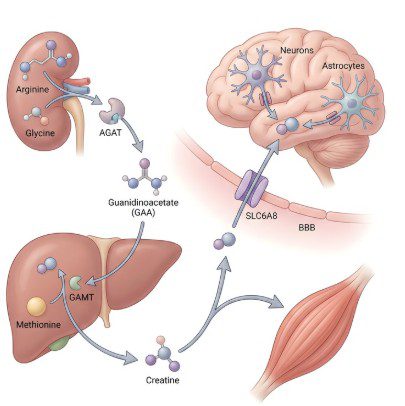
However, endogenous creatine production does not always appear to be sufficient, particularly during periods of increased metabolic demand or physiological stress, such as severe sleep deprivation (4).
So the crucial question is:
Kann eine Supplementierung die Kreatinspeicher im Gehirn erhöhen und dadurch die kognitive Leistungsfähigkeit verbessern?
Increasing Creatine Stores in the Brain
Recent research shows that even a single larger dose of creatine can raise brain creatine levels, suggesting that brain stores may be more responsive to supplementation than previously thought (4). However, because only a small amount of ingested creatine crosses into the brain, >may be needed to increase brain creatine stores than to saturate muscle stores. For example, seven days of creatine supplementation (0.3 g/kg/day) increased muscle creatine stores, but not brain creatine stores (5).
Other studies have reported measurable increases in brain creatine stores of approximately 3–9% (5, 6). Notably, these studies used substantially higher doses, typically 10–20 g of creatine per day.
One study directly compared three dosing strategies—2 g, 4 g, and 10 g of creatine per day. The results showed that 10 g daily increased brain phosphocreatine (PCr) stores significantly more than either 2 g or 4 g, suggesting a dose-dependent effect on brain creatine levels (7).
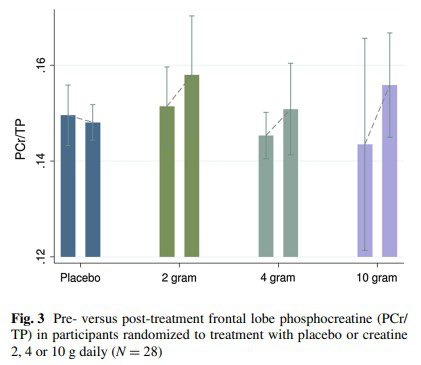
While promising, brain PCr stores typically increase by only around 10%, compared with 20–25% in muscle following creatine supplementation (8).
Reicht ein moderater Anstieg im Gehirn aus, um die kognitive Leistungsfähigkeit tatsächlich zu beeinflussen?

Cognitive Performance in the Office
The cognitive effects of creatine appear to depend on the task, the population studied, and the testing conditions. A recent meta-analysis found overall benefits for cognitively demanding thanks (9), but improvements were largely limited to specific aspects of memory performance:
🟢 Memory: small but reliable effect (SMD ≈ 0.31, moderate evidence)
🟡 Attention: small effect (SMD ≈ −0.31) — evidence uncertain
🟡 Processing speed: small to moderate (SMD ≈ −0.51) — high uncertainty (too little data)
🔴 General cognition: no significant effect
🔴 Complex and creative tasks: no significant effect
Besonderheiten: Hohes Alter & pflanzlich basierte Ernährung
Furthermore, creatine appears to be more effective in influencing cognitive performance in older individuals than in younger ones, which is attributed to the fact that with age, transport from the blood to the brain deteriorates and endogenous synthesis also decreases (10). Vegans and vegetarians also seem to benefit significantly more from supplementation (11), because dietary creatine intake is extremely low, making them more responsive to supplementation (12).

Cognitive Performance as an Athlete
There are promising indications that creatine could also positively influence certain cognitively demanding tasks in sports.
Studies with positive findings 🟢:
- For example, the study by Cook et al. (2011) showed that creatine reduced performance decrements in accuracy tasks under sleep deprivation in professional rugby players (11).
- Borchio et al. (2020) observed faster reaction times in mountain bikers after intense exertion (12).
- Similar effects were observed by Pires et al. (2021) in Muay Thai athletes: creatine improved reaction speed and executive advantages after exertion (13).
- Improved performance in a combination of technical aspects with simultaneous cognitive load in young basketball players (14).
Studies with no effect of creatine 🔴:
- Keine verbesserte Schussgenauigkeit bei Jugendfußballern (15).
Overall, creatine primarily seems to offer advantages in demanding, fatiguing situations – especially when cognitive and motor requirements are combined. However, a clear conclusion is difficult, as the loads and test procedures vary greatly between studies.
Neurodegenerative Diseases: Hope and Reality
Neuroprotective Properties
In addition to its effects on cognitive performance, the potential neuroprotective properties of creatine are increasingly becoming a focus of research. In particular, mechanistic studies provide promising evidence that creatine could have protective effects on nerve cells. For example, it has been shown that creatine protects neurons in vitro from β-amyloid (16), a central pathological marker of Alzheimer’s disease (17).
Explanation of β-amyloid plaques:
β-amyloid (Aβ) is a protein fragment that is continuously formed and degraded in a healthy brain. In Alzheimer’s, this balance is disrupted, leading to the accumulation and clumping of Aβ in the brain (18). Particularly problematic are not only the well-known amyloid plaques but, above all, small, soluble Aβ aggregates (oligomers). These are considered neurotoxic as they disrupt communication between nerve cells and impair synaptic functions – a central mechanism behind cognitive decline.
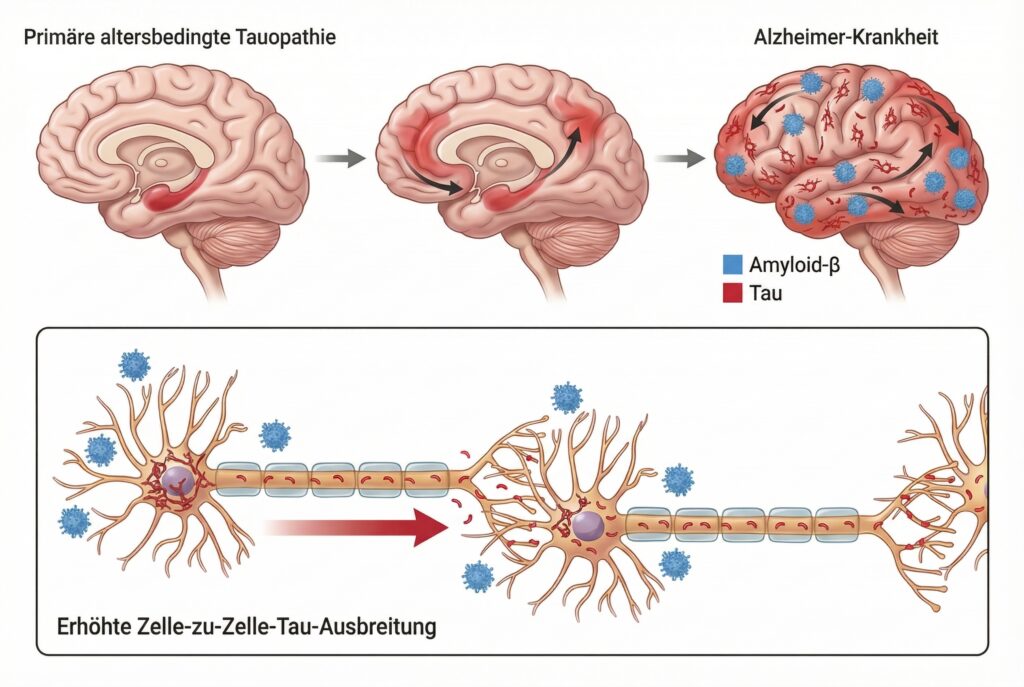
Within the framework of the so-called amyloid cascade hypothesis, Aβ is considered an early trigger of the disease. Its accumulation can initiate inflammatory processes, oxidative stress, and tau pathology, which ultimately leads to the loss of nerve cells. These processes often begin years before the first symptoms. Therefore, β-amyloid is considered one of the earliest markers of Alzheimer’s disease – but not the sole cause (18).
In animal models of Alzheimer’s disease, promising effects are observed. Here, creatine influenced, among other things, the processing of β-amyloid and the phosphorylation of tau proteins – two central processes in the development of neurodegenerative changes. These adaptations were accompanied by a reduced pathological burden in the brain (31). Although these results are not directly transferable to humans, they provide important mechanistic insights that creatine could potentially intervene in neurodegenerative processes beyond its role in energy metabolism.
Furthermore, creatine appears to stabilize cellular energy supply, modulate stress-related signaling pathways, and reduce so-called excitotoxic damage that can result from excessive activation of nerve cells (29, 30). Creatine seems to protect the integrity of the mitochondrial membrane and suppress the formation of free radicals (ROS), thereby reducing oxidative stress after injury.
In clinical research, creatine is often considered an “energetic lifeline.” Many neurodegenerative diseases share a central characteristic: impaired mitochondrial bioenergetics and a resulting cellular energy deficit, which ultimately leads to the death of neurons (31). Since the creatine kinase system is the most important instance for buffering ATP fluctuations, it is plausible that increasing brain stores could delay the progression of the disease. However, as the current state of research shows, the path from laboratory to clinical practice is complex.

Parkinson’s:
In Parkinson’s patients, oxidative stress is a dominant factor in the loss of dopaminergic neurons. In early animal models, creatine effectively protected these neurons from toxic attacks (32). However, large-scale human studies dampened the euphoria.
In a meta-analysis of 5 RCT studies (1339 participants in total), no effect of creatine on Parkinson’s-induced movement disorders (such as tremor) was found. A slightly positive effect was observed in the “Schwab & England Activities of Daily Living (S&E ADL) Score,” which assesses functional mobility in daily life (34).
One of the most comprehensive clinical investigations in the field of Parkinson’s observed 1,687 patients over five years with a daily intake of approximately 10 g of creatine (35).
The result was sobering: although creatine was safe and well-tolerated, it failed to significantly slow the clinical progression of motor symptoms compared to the placebo.
Alzheimer’s: Beyond Brain Pathology
Alzheimer’s patients often show reduced creatine levels in the brain, particularly in regions heavily affected by the pathology (32). Impaired glucose uptake and mitochondrial respiration are considered precursors to clinical symptoms (33).
However, there are currently no large-scale RCT studies with Alzheimer’s subjects. The only data we have, however, show that creatine in combination with strength training can positively influence muscle preservation and grip strength (34), which can certainly be important parameters for daily life.
Huntington’s Disease: Protection Against Brain Atrophy?
Huntington’s disease is characterized by progressive brain atrophy and severe energetic deficits. In this area, there is promising evidence of a structural protective effect. The PRECREST study demonstrated that supplementation of up to 30 g of creatine per day in early-stage patients could slow down brain atrophy (primarily in the striatum) (35). Overall, however, further studies are needed to better assess its effectiveness.
ALS and Multiple Sclerosis: Implementation Challenges
In amyotrophic lateral sclerosis (ALS), animal models raised hopes that creatine could prolong survival. However, this life-extending effect has not yet been confirmed in human studies (36, 37).
One possible reason for the failure of these studies could be the late timing of intervention: ALS patients are often only diagnosed when over 70% of motor neurons have already died (38). Nevertheless, pilot studies such as that by Mazzini et al. (2001) report a short-term improvement in knee extensor and elbow flexor strength, as well as reduced fatigue (39).
For Multiple Sclerosis (MS), the data is even scarcer. Since MS patients often show altered creatine metabolism patterns in the brain, there is theoretical potential. However, previous studies have not been able to demonstrate a significant increase in muscle strength or physical performance (40, 41).

The “Miracle Cure” for Sleep Deprivation
The effect of creatine on cognitive performance during acute sleep deprivation is well established.
In a study with professional rugby players who had slept only 3–5 hours, taking ~10 g of creatine almost completely compensated for the deterioration in passing accuracy caused by sleep deprivation (42).
In non-athletes, it was found in 2006 that subjects who took creatine showed better mood and faster reaction times after 24 hours of sleep deprivation (no sleep at all) (43).
However, it is questionable how important this truly is for practical application, because the subjects had not slept 2 or 3 hours less, but had not slept at all for 24 hours.
Conclusion: Is Creatine Worth It for the Brain?
🧠 Conclusion: Creatine is not a miracle cure for the brain, but it can have positive effects on cognitive performance in certain groups of people and in specific scenarios.
- 🟢 Memory: small but reliable effect
- 🟡 Attention & Processing: slight improvements, but uncertain data
- 🔴 General Cognition: no effect (no “getting smarter”)
- 🔴 Creative & Complex Tasks: no improvement
- 🟢 In Athletes under Stress: improved reaction time, focus & technical precision
- 🟡🔴Neurodegenerative Diseases: Promising mechanistic data, long-term studies in humans show no effect effect.
- Older adults & vegans and vegetarians likely benefit the most
- The effect depends on the type of cognitive task (test), stress, dosage, and dietary creatine intake.
👉 Bottom line: No across-the-board cognitive boost — rather, targeted effects in specific situations.

0 Comments