


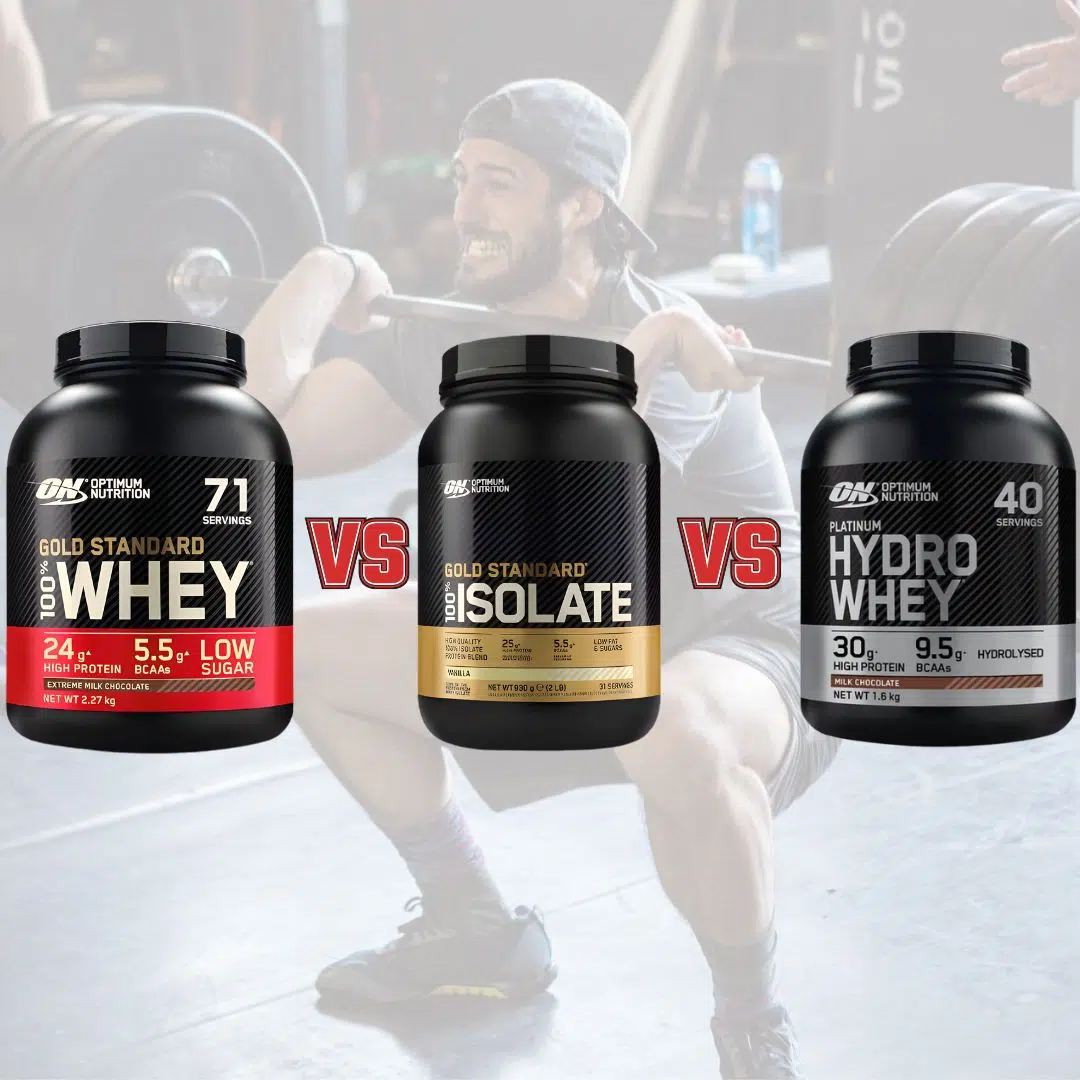

🏋️ Sports Nutrition · Evidence-Based
Whey Concentrate, Isolate, Hydrolysate, Casein – which protein powder is truly worthwhile for athletes?
The supplement industry earns billions from differences that are hardly scientifically relevant. But which protein is truly the best for muscle building and performance?
In this article, you will learn which whey protein is worthwhile, what studies actually show, and how you as an athlete can save money.
All roads lead to milk – the basis of whey protein
Whether it is inexpensive whey protein concentrate or expensive hydrolysate – almost all protein powders on the market have the same origin: cow’s milk. It consists of approximately 80% casein and 20% whey protein. What distinguishes the products is not the amino acid composition, but exclusively the processing and purification process afterward (1).
That sounds simple – and it is. Nevertheless, manufacturers have managed to create an entire product universe from this single raw material source that gives the impression: the more expensive, the better the results. This article shows you what science has to say about it.
The most important protein powders compared
🥛 Whey Protein Concentrate (~75–80% protein)
👉 Best value for money for muscle building
During cheese production, casein precipitates through enzymatic coagulation – the remaining whey is filtered and spray-dried. The result still contains small amounts of lactose and fat. For most athletes, this is completely sufficient – and usually the least expensive product on the shelf (2).
🔬 Whey Protein Isolate (>90% protein)
👉 Virtually lactose-free – but no advantage for muscle building
Same raw material, further purified form: Through finer membrane processes or ion exchange, lactose and fat are almost completely removed. The protein content increases to over 90%. The question is: Does a healthy athlete really need this (2)?
⚡ Whey Protein Hydrolysate (pre-digested)
👉 Fastest absorption – but no measurable added benefit
Not a further purification step, but a structural modification: enzymes break down whey proteins into shorter peptides that enter the bloodstream more quickly. In theory, this sounds like an advantage – practice shows a different picture (more on this shortly) (2).
🌙 Casein (slow-release)
👉 Ideal for overnight recovery
Casein does not come from whey, but from the cheese curd. Its natural micellar structure forms a gel in the stomach that slows amino acid release over several hours – physiologically fundamentally different from whey. Optimal as an evening shake or during long meal breaks (3).
What the supplement industry does not tell you about protein powder
This is where it gets interesting – and a bit uncomfortable for the industry. Looking at the marketing promises, one gets the impression that isolate is clearly superior to concentrate and hydrolysate is superior to isolate. More purity, faster absorption, better results. But what does science say?
⚠️ Critical perspective: The supplement industry suggests that a higher purity level directly leads to more muscle growth. This conclusion is not scientifically valid—and it costs athletes unnecessarily large amounts of money every year.
The decisive marker is muscle protein synthesis (MPS) – that is, how strongly a protein stimulates muscle building and muscle recovery. And here, studies provide a clear picture: No hydrolysate has significantly surpassed whey concentrate or isolate in activating MPS (4).
Interestingly: hydrolysate does indeed achieve higher peak amino acid and leucine levels in the blood more quickly – both at rest and after strength training – than whey concentrate (5). That initially sounds like an advantage. However, in the study mentioned, MPS itself was not measured at all – and that is precisely the point: A higher leucine peak in the blood does not automatically mean more muscle building. The kinetics are faster, the result remains the same.
This is also confirmed by an 8-week training study in which hydrolysate was compared against two concentrate products and placebo: there were no significant differences between the protein groups in muscle gain and strength development. Only in fat reduction did the hydrolysate group show a slight advantage – a finding that hardly matters in practice (6).
The same applies to the comparison of isolate vs. concentrate: the marginally higher purity of isolate does not lead to any measurable added value in MPS for healthy, lactose-tolerant athletes. Whey concentrate is completely sufficient – no disadvantage compared to isolate or hydrolysate.
Absorption rate of protein powders compared
Differences between whey variants exist but are minor – and are not reflected in MPS.
Proteintyp | Resorptions-geschwindigkeit | MPS-Aktivierung |
🌙 Casein | Langsam (5–7 Std.) | Nicht gut nach dem Training – ideal für Nacht / lange Fastenzeiten |
🥛 Whey-Konzentrat | Schnell | Gut |
🔬 Whey-Isolat | Schnell | Gut, aber kein signifikanter Vorteil gegenüber einem Konzentrat |
⚡ Whey-Hydrolysat | Sehr schnell | Gut, aber kein signifikanter Vorteil gegenüber einem Konzentrat |
💡 Note: Faster absorption does not automatically mean more muscle growth. What matters is daily protein intake.
When isolate or hydrolysate still makes sense
There are legitimate reasons to choose more expensive products – they are just not performance reasons. Lactose intolerance is the clearest: isolate and hydrolysate are virtually lactose-free and therefore the better choice for those affected. Anyone who monitors every gram of fat and carbohydrates – for example, in a strict competition diet – can calculate more precisely with isolate. But that is largely it.
✅ Bottom Line: For the overwhelming majority of athletes, a good whey concentrate is the smartest choice: scientifically just as effective, significantly more affordable—and the money saved can be invested more wisely in whole foods.
Differences in production
Whey protein is produced as a by-product of cheese making from liquid whey, then concentrated by filtration and subsequently dried. With whey protein concentrate, small amounts of lactose and fat are still present. With whey protein isolate, additional filtration or ion exchange is used, increasing the protein content to over 90% and largely removing lactose and fat. whey protein hydrolysate is partially pre-digested enzymatically, producing shorter peptides that can be absorbed more quickly. casein protein, on the other hand, is obtained directly from the solid milk protein fraction, separated from the whey and dried (2).
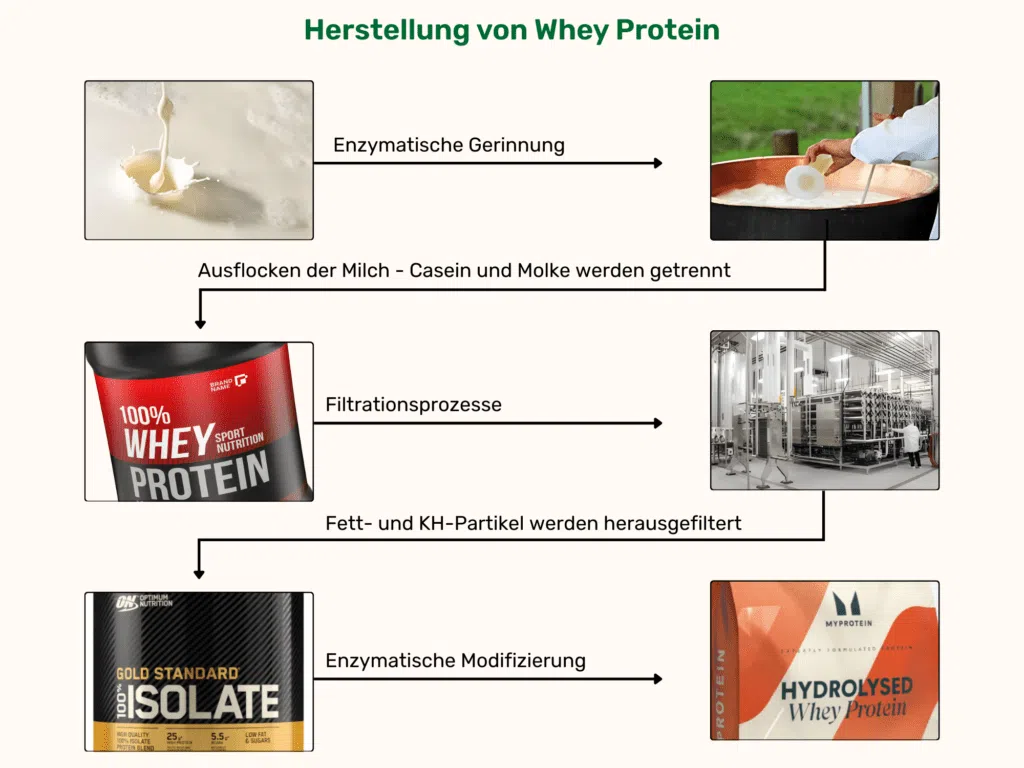
Schematic illustration of whey protein production
Who is each option suitable for?
The honest summary
Situation | Empfehlung |
💪 Gesunder Sportler (Aufbau/Kraft) | Whey-Konzentrat reicht vollständig aus. Kein messbarer Nachteil gegenüber Isolat oder Hydrolysat. |
🥛 Laktoseintoleranz | Whey-Isolat oder -Hydrolysat wählen – beide sind praktisch laktosefrei. |
🌙 Regeneration über Nacht | Casein – langsame Freisetzung versorgt die Muskeln über den Schlaf hinweg. |
🏆 Wettkampfdiät / Kalorienpräzision | Isolat für minimalen Fett- und KH-Anteil – aber kein Leistungsvorteil. |
💰 Bestes Preis-Leistungs-Verhältnis | Whey-Konzentrat von einer seriösen Marke. Punkt. |


0 Comments