




Sports Nutrition & Performance | Reading time: approx. 5 minutes | Scientifically proven
Optimizing carbohydrate use, avoiding digestive issues
Those who train intensely need energy – and carbohydrates are the quickest source. However, what, how much, and when you eat before training not only determines your performance but also whether you struggle with cramps, bloating, or diarrhea. This article shows you how to optimize your pre-workout nutrition, boost your performance, and avoid common digestive issues.
1. Why carbohydrates are crucial before training
Muscle glycogen – the sugar stored in muscle tissue – is the most important energy source for intense strength and endurance training. If glycogen stores are depleted or reduced, performance measurably declines, and training intensity cannot be sustained (1). A carbohydrate-rich meal before training helps to replenish glycogen stores while simultaneously supplying the liver with sufficient carbohydrates. This keeps blood sugar levels stable during training – a crucial advantage compared to training in a fasted state. Especially during longer sessions exceeding 60 minutes, adequate carbohydrate intake positively impacts performance, endurance, and training quality (2).
2. How many carbohydrates do you need before training?
The recommended amount depends on the time interval before training. The recommendations from the “International Society of Sports Nutrition,” formulated based on several controlled studies, can serve as a good guide (2).
- 3–4 hours before: 2–3 g of carbohydrates per kg of body weight. For a body weight of 75 kg, this corresponds to 150–225 g – essentially a full main meal.
- 1–2 hours before: 1–2 g/kg – a medium-sized pre-workout snack (75–150 g for a 75 kg person)
- Less than 60 minutes before: 0.5–1 g/kg (fast-acting carbohydrates that are easily digestible)
Important! You do not necessarily have to consume all three meal options listed; rather, the goal is to adjust portion size specifically to the timing of your last meal. More on this below!
3. Adjust the timing to the meal size
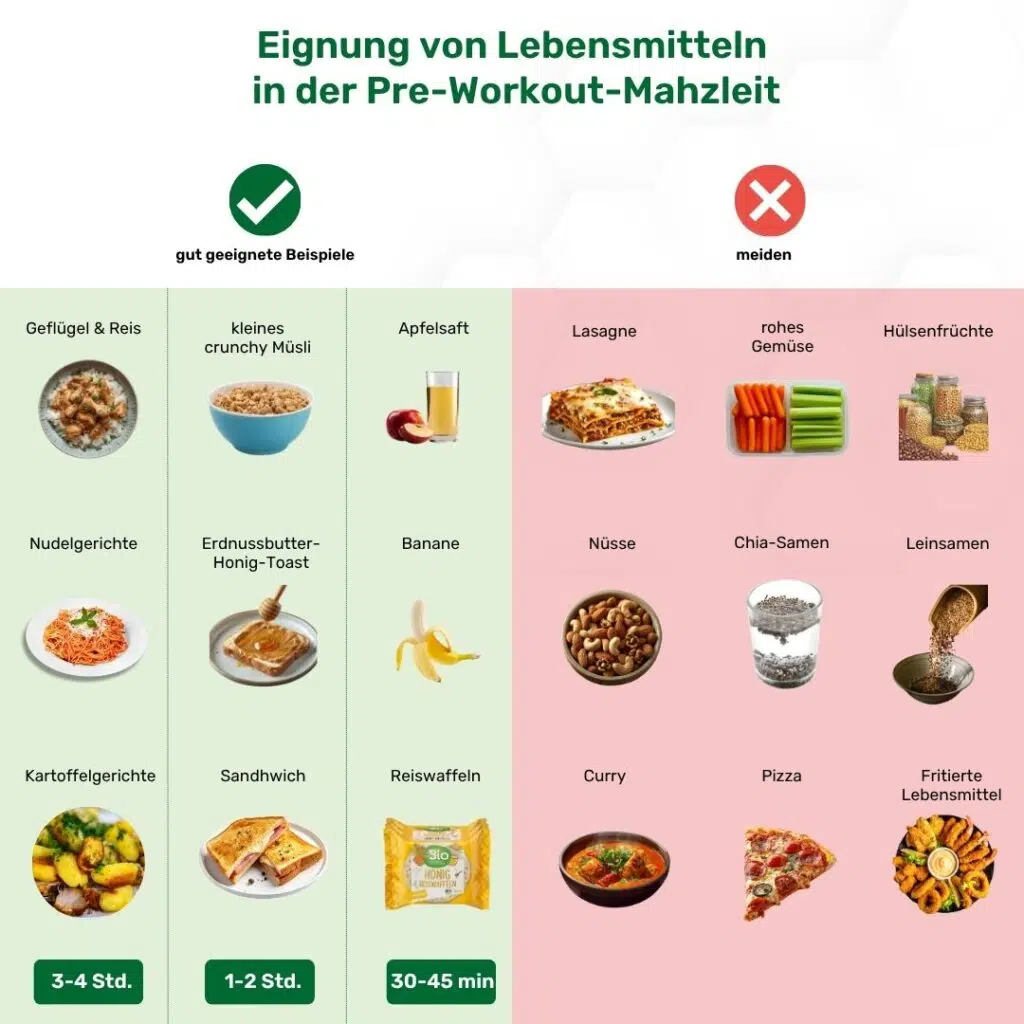
A large portion of pasta just before training sounds tempting – but it is a common mistake. Your stomach needs time: complex, fiber-rich meals remain in the digestive tract for 3–4 hours, and fatty foods even longer (x). If you train on a full stomach, a direct conflict arises: at maximum exertion, splanchnic blood flow – the blood supply to your intestines – can be reduced by up to 80% to adequately supply the working muscles. Therefore, you should specifically adjust the timing of your pre-workout meal to its size and composition.
Allgemein gilt: Je größer die Mahlzeit und je mehr komplexe Kohlenhydrate und Fette sie enthält, desto länger sollte der zeitliche Abstand zum Sport sein
Gute Kohlenhydratquellen je nach Timing:
- 3–4 hours before: Oats, whole grain products, brown rice, potatoes
- 1.5–2 hours beforehand: Bread, sandwich, small serving of crunchy muesli
- Under 60 min.: Rice cakes, ripe banana, sports drink, gel, juice spritzer
4. Training scenarios: Morning, Noon, Evening
Hier einmal mehrere Beispiele, wie man die Pre-Workout-Mahlzeit gezielt an die Trainingszeit anpassen kann:
Variante 1) – Training um 18 Uhr abends: Mann isst gegen 13 Uhr eine vollwertige Mahlzeit und um 16 Uhr noch einmal einen größeren Snack, wie einen gefüllten Wrap oder Sandwich und einen kleinen Smoothie
Variante 2) – Training am Mittag gegen 12 Uhr: Um 7.30 Uhr wird ein größeres Frühstück eingenommen und um 10.30 Uhr dann noch einmal 2 Portionen eines kleinen Carb-Snacks zu sich – zum Beispiel 1 x Gel + Banane oder 1 Portion eines größeren Snacks, wie ein Bulgur-Salat.
Variante 3) – Man trainiert morgens: Hier trinkt man direkt nach dem Aufstehen ca. 5 ml Wasser pro kg Körpergewicht und nimmt 2 Portionen eines kleinen Carb-Snacks zu sich – zum Beispiel 1 x Gel + Banane
Für leistungsorientiertes Training und längere Einheiten (über 90 Minuten bei hoher Intensität) werden 75–150 g Kohlenhydrate sowie 10–30 g Protein empfohlen. Diese Kombination unterstützt die Energieversorgung und kann die Leistungsfähigkeit während des Trainings verbessern. Bei kürzeren oder niedrigintensiven Einheiten genügen hingegen 0–75 g Kohlenhydrate – in manchen Fällen ist auch nüchternes Training möglich, abhängig vom individuellen Trainingsziel (9). Die optimale Menge richtet sich zudem nach dem Körperbau: Leichtere Personen können sich am unteren Bereich der Empfehlungen orientieren, während größere und muskulösere Männer tendenziell höhere Mengen benötigen. Leichtere Personen können sich dabei am unteren Ende der Werte orientieren, große, muskulöse Männer eher am oberen Ende der Empfehlungswerte.
5. Digestive problems during training: Causes and solutions
Gastrointestinal complaints such as cramps, nausea, or diarrhea are widespread in endurance sports – depending on the sport and intensity, up to 90% of athletes report them. The reason: during intense exertion, blood flow to the digestive tract is significantly reduced, which slows gastric emptying and impairs nutrient absorption (10).
An unfavorably composed pre-workout meal can significantly exacerbate these problems. Therefore, the following aspects should be considered:
-
- Schwer verdaulich und daher eher meiden: ballaststoffreiche Lebensmittel wie rohes Gemüse, Hülsenfrüchte oder Vollkornprodukte mit hohem Ballaststoffanteil
-
- Schwer verdaulich und daher eher meiden: Größere Mengen an Fett, wie Nüsse, Öle oder fettiges Fleisch, verlangsamen die Magenentleerung und erhöhen die mechanische Belastung des Darms – sie sollten in den letzten 1–2 Stunden vor dem Training gemieden werden.
-
- Schwer verdaulich und daher eher meiden: Auch große Proteinmengen und Milchprodukte – insbesondere bei milder Laktoseintoleranz, die unter Belastung symptomatisch werden kann – sind in der unmittelbaren Pre-Workout-Phase ungünstig
-
- Meiden: Hochverarbeitete Fertigprodukte, wie die meisten Proteinriegel oder Fast-Food-Lebensmittel, enthalten viele Zutaten mit hohem FODMAP-Anteil und erhöhen das Risiko für Magen-Darm-Beschwerden (11).
-
- Dehydration: Selbst leichte Dehydration verlangsamt die Magenentleerung und verstärkt gastrointestinale Beschwerden. Deswegen 5–7 ml Flüssigkeit pro kg Körpergewicht in den 2–4 Stunden vor dem Training trinken (12)
- Timing: Wer weniger als eine Stunde vor dem Training groß isst, riskiert, dass der Magen noch beschäftigt ist – das Blut wird zur Verdauung umgeleitet, nicht zur Muskulatur (13)
Wichtig: Dies sind allgemeine Empfehlungen und dasselbe Lebensmittel kann von einer Person sehr gut und von der anderen weniger gut vertragen werden.
6. The FODMAP diet: Help for persistent digestive problems
What are FODMAPs?
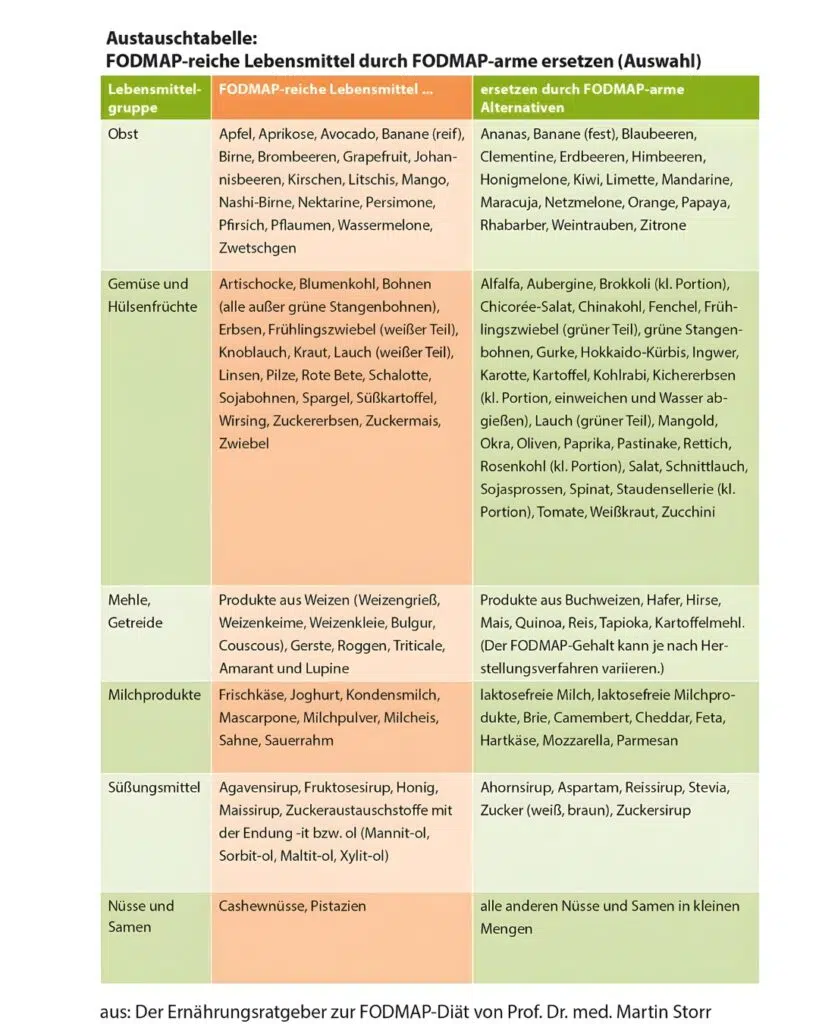
The FODMAP diet is a nutritional approach originally developed to treat irritable bowel syndrome (IBS). The acronym stands for fermentable oligosaccharides, disaccharides, monosaccharides, and polyols—a group of poorly absorbed, short-chain carbohydrates that are not fully absorbed in the small intestine. They draw water into the gut and are rapidly fermented by gut bacteria, which can trigger bloating, cramping, a feeling of fullness, and diarrhea (13). High-FODMAP foods include onions, garlic, legumes, wheat, dairy products containing lactose, apples, and pears.
Why is this relevant for athletes?
Many typical athlete meals are high in FODMAPs: wheat bread, honey, apples, pears, legumes, dairy products, and many sports gels with sugar alcohols. In combination with training-induced gastrointestinal stress – reduced intestinal blood flow, increased intestinal permeability (14) – these foods can trigger or worsen symptoms. A pilot study with endurance athletes showed that a low-FODMAP diet in the 24 hours before a long run significantly reduced gastrointestinal distress – without performance impairment (15).
Common FODMAP sources in an athlete’s daily life
- Fructans: Wheat, rye, onions, garlic – classic ingredients in bread, cereal bars, and ready meals
- Lactose: Milk, yogurt, soft cheese
- Fructose: Apples, pears, mango, honey, agave syrup
- Polyols: Cherries, peaches, avocado, sugar alcohols (sorbitol, mannitol) in chewing gums, sports gels, and light products
Examples of foods that are low in FODMAPs:
White rice, ripe bananas (small amount), oats in small portions, strawberries, blueberries, rice cakes, potatoes, white bread (sourdough or gluten-free).
Important: The low-FODMAP diet is not a long-term meal-plan for everyone, but rather a diagnostic tool for athletes with functional gastrointestinal symptoms. Strict adherence over the long term can have a negative impact on gut flora (15). Ideally, it should be followed under the guidance of a registered dietitian.
The most important principles
- Carbohydrates are key: 1–3 g/kg of body weight depending on the time interval before training – this is the most important factor.
- Adjust timing: The longer the interval before training, the larger and harder to digest the meal can be.
- Complex Carbs 3-4 hours before training: Oats, brown rice, and potatoes provide more stable energy than high-glycemic snacks.
- Fats, fiber, and highly processed foods The most common triggers of stomach problems, and therefore best avoided.
- Start well hydrated: Drink 5–7 ml of water per kg of body weight in the 2–4 hours before training
- For persistent digestive problems: Test a low-FODMAP approach around intense sessions – ideally with professional guidance.
🧩 Wir helfen dir gerne in unserem 1:1 Ernährungscoaching weiter und passen deine Ernährung individuell an deine Bedürfnisse an!




0 Comments