



The pre-workout meal is one of the most frequently discussed topics in sports nutrition—and simultaneously one of the most misunderstood. Many believe it must always be a large meal containing as many carbohydrates as possible. But is that actually true? This article provides a science-based overview of the physiology of pre-workout nutrition and how training performance influences different muscle structures, affecting metabolism and performance under various scenarios.
Why is the pre-workout meal relevant at all?
Carbohydrates are the superior energy source for high-intensity exercise—and for a simple biochemical reason: through glycolysis, glycogen can be converted to ATP significantly faster than fat, which must first be mobilized from adipose tissue, transported, and only then metabolized via beta-oxidation. At higher intensities (above 70–80% VO₂max), ATP can be produced approximately 4.5 times faster via anaerobic glycolysis than fats via beta-oxidation (1).
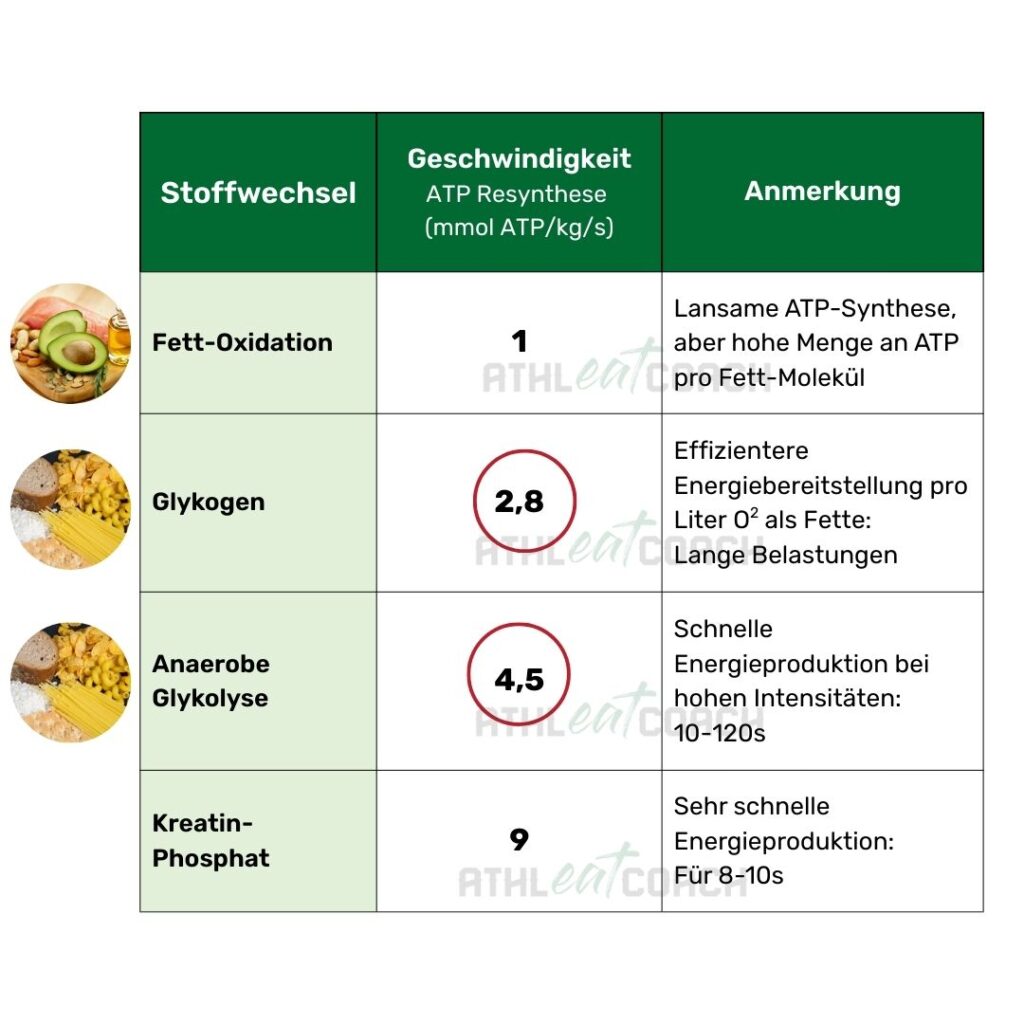
Take note!
Carbohydrates can be converted into energy ~3 – 4.5 times faster than fats.
So, carbs are important and more effective than fats. So far, so good.
But does this automatically mean that every pre-workout meal should primarily consist of carbs? And what about the timing of the meal?
The body can store a limited amount of carbohydrates in the muscles and the liver. Mobilizing these energy stores is more effective than drawing carbohydrates directly from the bloodstream. This makes sense, as muscle glycogen is already located where it is to be metabolically processed for energy.
In total, we can store approximately 300–500 g of glycogen in the skeletal muscles and about 100 g of glycogen in the liver (2). Once these stores are depleted, performance drops measurably.
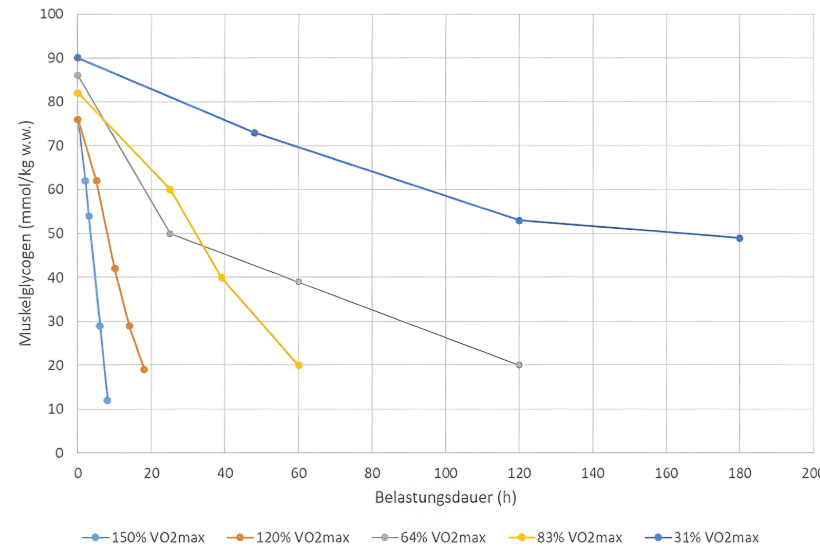
Source: Jeukendrup, A., & Gleeson, M. (2019). Sport nutrition. Human Kinetics.
After intensive endurance training, stores are already relatively empty after about 75 min. In contrast, during strength training, stores are only depleted by approximately 30–40% (2, 3). The type of training and the load therefore have a major influence on the extent of glycogen depletion during exercise (2).
But what exactly does this have to do with the pre-workout meal?
- The primary function of the pre-workout meal is to further replenish glycogen stores so that you enter training with full glycogen levels.
- At the same time, the meal should be easily digestible and well-tolerated to avoid gastrointestinal issues.
This also leads to the question: do we necessarily need a pre-workout meal high in carbs if the glycogen stores are already full?
The problem: Glycogen resynthesizes slowly—even with a high carbohydrate intake of 8–10 g/kg, stores are only replenished by 2.5% per hour (4). After a two-hour intensive training session that reduces stores by around 50%, full replenishment takes 20–24 hours (5). Those who train regularly and intensively must therefore continuously consume sufficient carbohydrates—not just directly after training, but throughout the entire day—to ensure that glycogen stores are fully replenished for the next session. A high proportion of carbohydrates in the pre-workout meal therefore makes sense for competitive athletes who regularly deplete their glycogen stores due to a high training volume.
Conversely, this also means that recreational athletes with a lower training volume require fewer carbohydrates.
Those who “only” exercise 3 times a week do not necessarily need a top-up with extra carbs before every training session. Furthermore, we now know from several studies that fasted training (i.e., eating nothing before exercise) does not negatively affect moderately long endurance sessions at low intensity.
Fasted Training Studies
-
In a study (6) involving trained cyclists, a 20-minute graded exercise test to just below VT + HIIT component was performed, and there were no differences in performance, RPE, or hunger between:
- Breakfast with 1 g/kg CHO
- High-protein breakfast without carbs
- Water
‼️The intensity during the submaximal phases was at 60–100% of the ventilatory threshold, which is clearly in the low to moderate range ‼️
-
In a 6-week intervention with cycling training 4×/week at ~70% VO₂max (1–1.5 h), groups that consistently trained fasted vs. those well-supplied with carbs had identical increases in VO₂max (+9%) and 60-min time trial performance (+8%) (7). The sessions were all performed in a fasted state; despite higher fat oxidation and metabolic adaptations, no performance disadvantage was observed at this intensity.
-
A 4-week running program with periodized “fasted” vs. “fed” low-intensity training (LIT) found similar VO₂peak improvements in both groups; only the fasted group also improved anaerobic capacity and maximum running speed, without any loss in submaximal performance (8).
The studies mentioned are deliberately chosen as examples—they show that training with little or no carbohydrates does not automatically lead to performance losses. While carbohydrates are fundamentally the most important energy source for intensive exercise, how much is actually needed before training depends heavily on the individual training context: intensity, duration, and above all, training frequency determine how full the glycogen stores must be before the next session. As a rule of thumb: the higher the training frequency and the more intensive the sessions, the more important a targeted high carbohydrate content in the pre-workout meal becomes.
Composition of the Pre-Workout Meal
The most important question in this context is, of course, how the meal before exercise should be structured and when it should be consumed. First, it is important to understand that the two components—meal composition and timing—influence each other. The rule here is: the larger a meal is, the greater the time interval before exercise should be, simply because it takes longer for the most important digestive processes to be completed.
Therefore, use the following rule of thumb:
- Main meal: approx. 3 hours before exercise (up to 4 hours before exercise if high in fiber)
- If the last large meal is consumed 4 hours or more before exercise, an additional easily digestible, high-carbohydrate snack should be consumed.
- 1 small high-carbohydrate snack 30 – 60 min before exercise, if the main meal was eaten approx. 4 hours before exercise.
- 1 larger high-carbohydrate snack 2 hours before exercise, if the main meal was consumed approx. 5 hours before exercise.
- 2 smaller portions of a high-carbohydrate snack for morning training (high intensity), where one portion should be consumed in liquid form, such as juice.
- Light training sessions can also be completed on an empty stomach, provided no more intense exertion occurs within 24 hours.
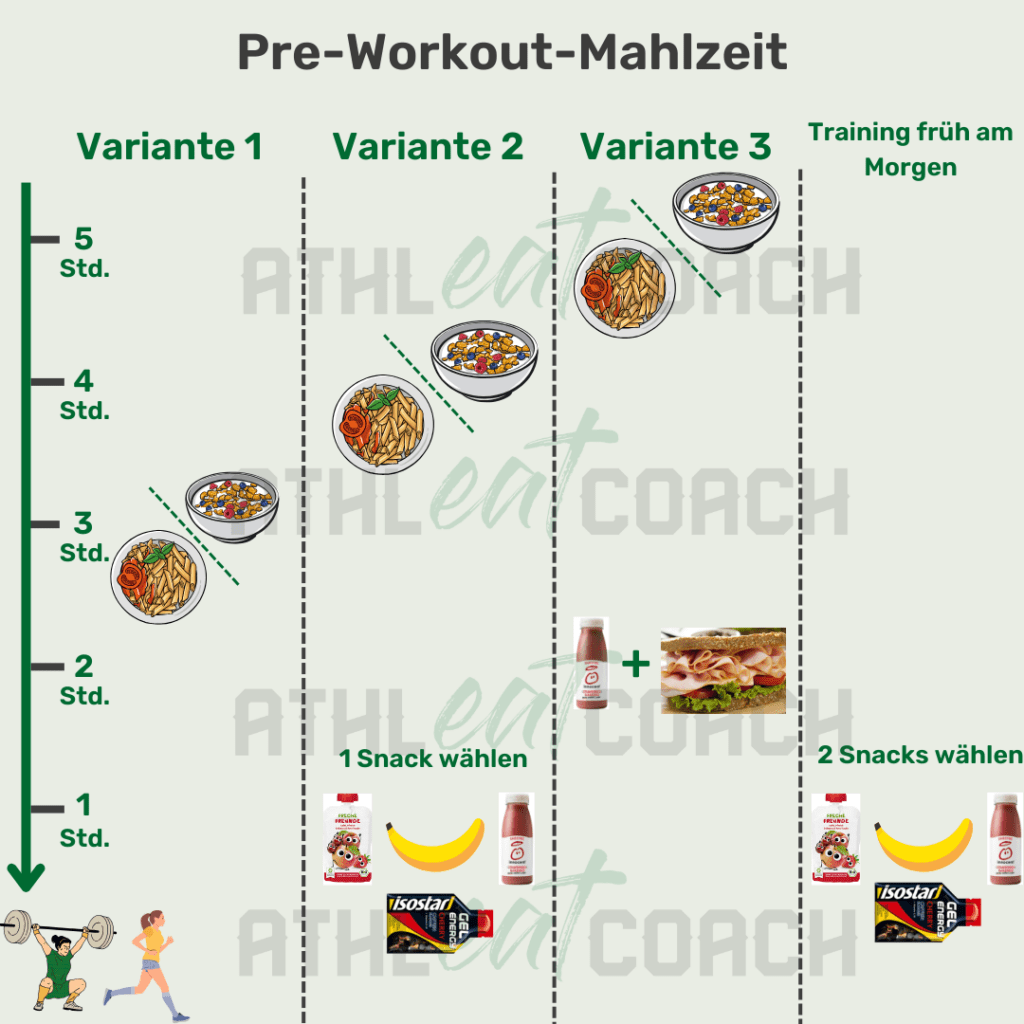
In practice, this could look like the following, for example:
Option 1) – Training at 6 PM: You eat a full meal around 1 PM and another larger snack around 4 PM, such as a filled wrap or sandwich and a small smoothie.
Option 2) – Training at midday around 12 PM: A larger breakfast is eaten at 7:30 AM, followed by 2 portions of a small carb snack at 10:30 AM—for example, 1 x gel + banana or 1 portion of a larger snack, such as a bulgur salad.
Option 3) – Training in the morning: Here, you drink approx. 5 ml of water per kg of body weight immediately after waking up and consume 2 portions of a small carb snack—for example, 1 x gel + banana.
For performance-oriented training and longer sessions (> 90 min, high intensity), 75–150 g of carbohydrates plus 10–30 g of protein are recommended. For shorter or low-intensity sessions, 0–75 g of carbohydrates or even fasted training is sufficient—depending on the goal (9). Lighter individuals can aim for the lower end of these values, while large, muscular men should lean toward the upper end of the recommended values.
Avoiding Digestive Problems
Gastrointestinal complaints such as cramps, nausea, or diarrhea are widespread in endurance sports—depending on the sport and intensity, up to 90% of athletes report them. The reason: during intensive exercise, blood flow to the digestive tract is significantly reduced, which slows gastric emptying and impairs nutrient absorption (10).
An unfavorably composed pre-workout meal can significantly exacerbate these problems. Therefore, the following foods should generally be avoided:
- High-fiber foods such as raw vegetables, legumes, or whole-grain products with a high fiber content.
- Large amounts of fat, such as nuts, oils, or fatty meat, slow down gastric emptying and increase the mechanical load on the intestine—they should be avoided in the last 1–2 hours before training.
- Large amounts of protein and dairy products—especially in cases of mild lactose intolerance, which can become symptomatic under exertion—are also unfavorable in the immediate pre-workout phase.
- Highly processed ready-made products, such as most bars or fast food.
Important: These are general recommendations, and the same food may be tolerated very well by one person and less well by another.
FODMAP – A Solution for Severe Digestive Problems
The FODMAP diet is a nutritional approach originally developed to treat irritable bowel syndrome (IBS). The acronym stands for fermentable oligosaccharides, disaccharides, monosaccharides, and polyols—a group of poorly absorbed, short-chain carbohydrates that are not fully absorbed in the small intestine. They draw water into the intestine and are rapidly fermented by gut bacteria, which can trigger bloating, cramps, a feeling of fullness, and diarrhea (11). Foods with a high FODMAP content include onions, garlic, legumes, wheat, dairy products containing lactose, apples, and pears.
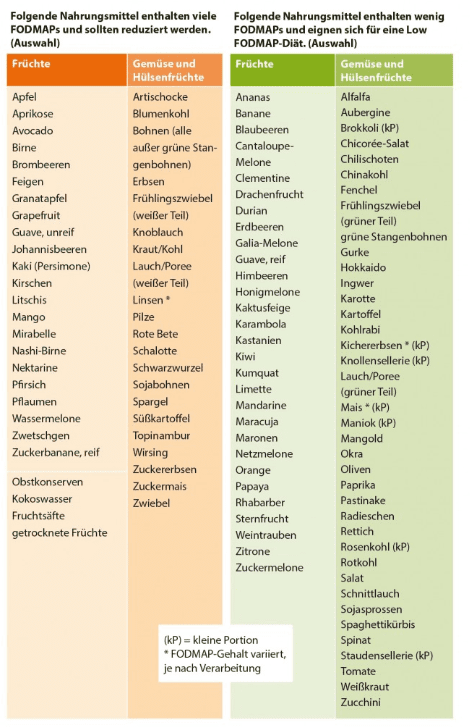
Source: Storr, M. (2017). FODMAP-Kompass: Tabellenband zur Low-FODMAP Diät mit Bewertung von über 500 Lebensmitteln und Nahrungsmittelzusatzstoffen.
This mechanism is particularly relevant for endurance athletes, as blood flow to the digestive tract is significantly reduced during intensive exercise and the intestinal barrier becomes more permeable—meaning the gut generally reacts more sensitively to dietary stimuli. A short-term reduction in FODMAPs in the 24–48 hours before a competition can significantly reduce gastrointestinal symptoms during exercise (12).
- In a cross-over study, 16 subjects initially followed either a low-FODMAP or a high-FODMAP diet for seven days before the groups switched. Under the low-FODMAP diet, the IBS-SSS total score was reduced by 61.3% (12).
- A case study involving a triathlete reports that after six days of low-FODMAP, all GI symptom scores dropped to zero—previously, they ranged between 0 and 4 under a normal diet (13).
- In another intervention study with 11 runners, 9 out of 11 athletes reported fewer GI complaints while on the low-FODMAP diet (14).
An important practical note: the low-FODMAP diet restricts many high-carbohydrate foods, which can be problematic when carbohydrate requirements are high. The goal should therefore not be to eliminate all FODMAPs, but to specifically identify the strongest individual triggers and avoid them during competition preparation—ideally accompanied by nutrition experts like us. Well-tolerated, low-FODMAP-compliant carbohydrate sources before a race include white rice, potatoes, sourdough white bread, ripe bananas, and oats in moderate amounts.
Eating Before Exercise: Avoiding Hypoglycemia
Another factor often overestimated in discussions about pre-workout nutrition is so-called reactive hypoglycemia caused by high-glycemic carbohydrates. The theory: a rapid rise in blood sugar provokes a strong insulin release, which not only returns blood sugar to the normal range (4.4–6.6 mmol/l) but pushes it below 3 mmol/l, thus leading to hypoglycemia.
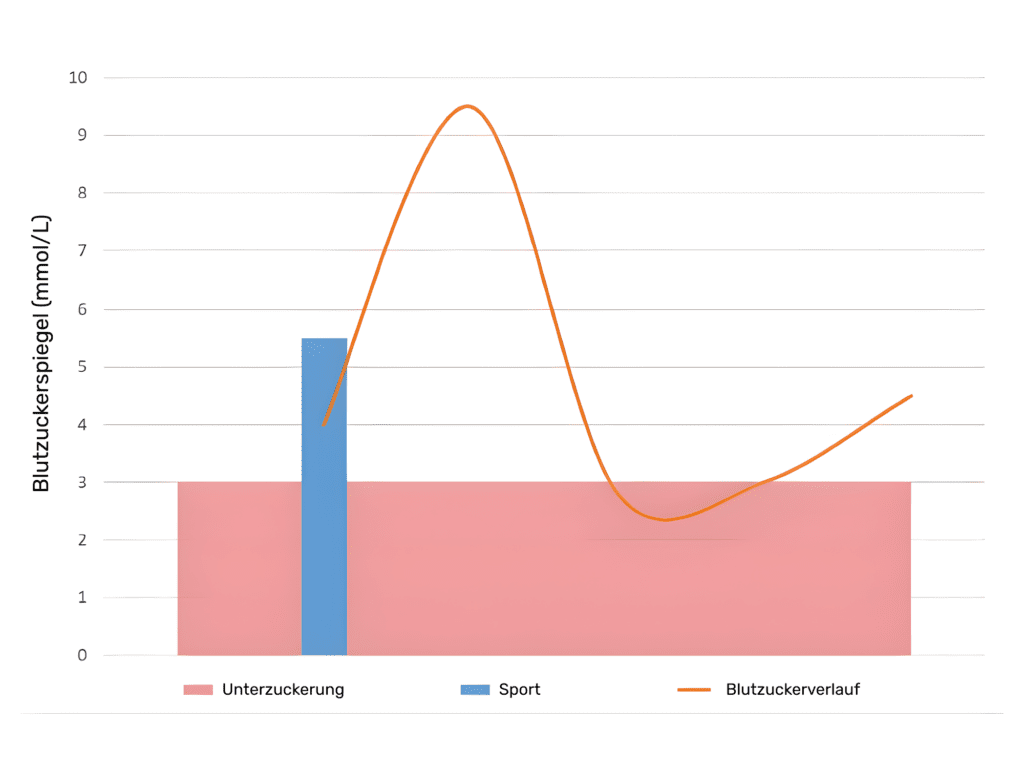
This physiological connection is sometimes used as an argument that high-glycemic foods should be avoided before exercise, as this leads to hypoglycemia and thus also to performance losses. In practice, however, this phenomenon only occurs under very specific conditions: namely, when training is performed completely fasted beforehand and no further carbohydrates are supplied during the exercise (15).
For most athletes, the glycemic index of the pre-workout meal plays a smaller role than is often claimed. A meal with a low glycemic load only provides a real advantage if further carbohydrates are completely avoided during the entire exercise—for example, during long endurance sessions without gels or sports drinks (16). In addition, not every body reacts the same way—the extent to which a reactive drop in blood sugar occurs, or whether it occurs at all, varies from person to person and has no noticeable performance consequences for most athletes.
Ultimately, the best pre-workout meal is simply the one that works for you personally—and that can only be found through trial and error. What the stomach and performance can handle should therefore be tested during training rather than at the next competition.
Please feel free to download our coaching brochure if you would like to get an idea of our philosophy beforehand. In any case, we always offer all interested parties a free information call to explain how we would proceed in your specific case. Feel free to register here for a non-binding information call – you only stand to gain and have nothing to lose!

0 Comments