


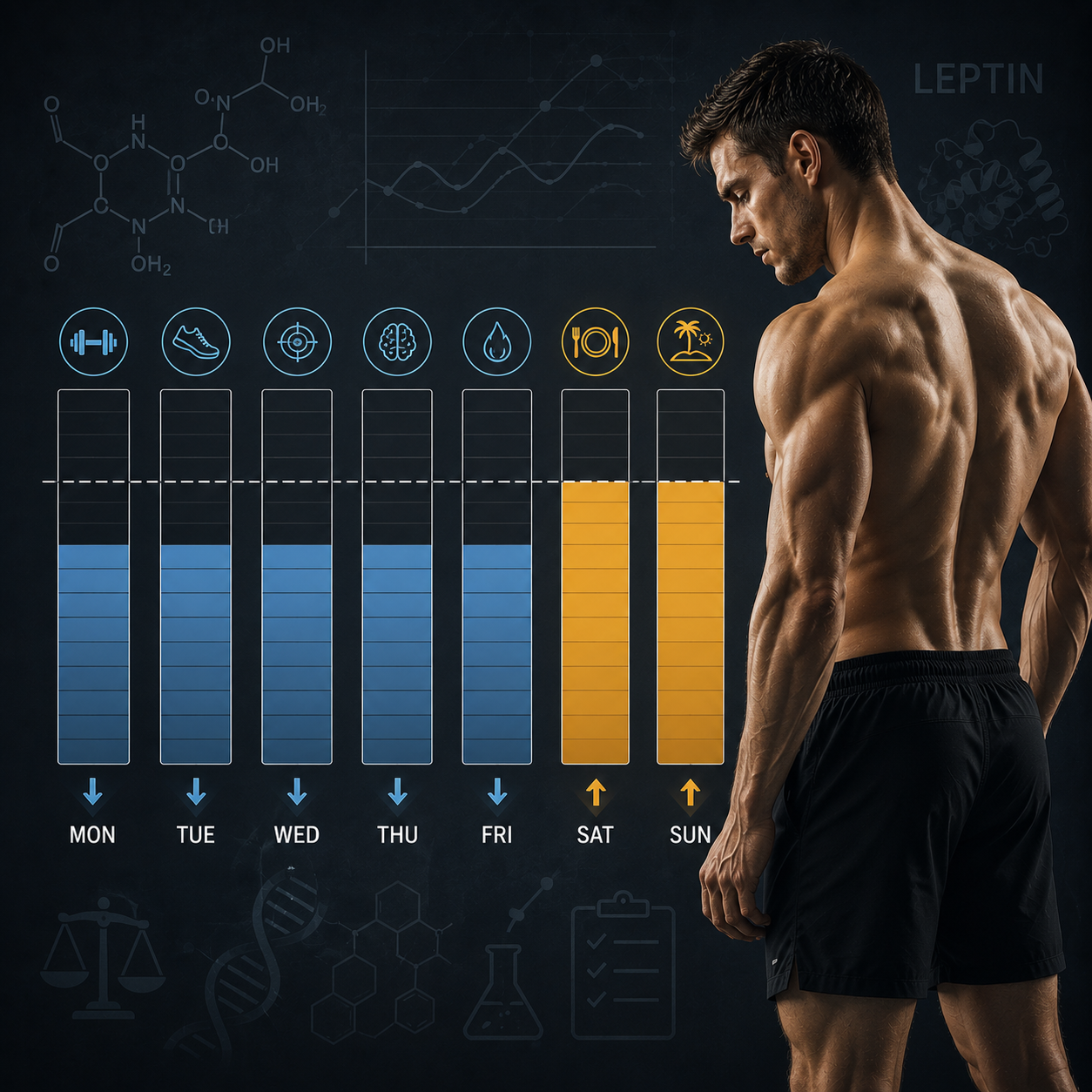

Generally speaking, when you’re on a diet, you simply “have to” eat fewer calories than you burn;
Calories in <, calories out.
On a physiological level, however, much more is happening, of course. As energy restriction increases, hunger, hormonal signals, and—later on—metabolism all change. The key term here is “metabolic adaptation”—the body adapts to a consistently low energy intake, becomes more efficient, and expends less energy. This is precisely the basis for the concept of refeeds and diet breaks: If the body responds to a deficit by making adjustments, a planned phase of higher energy intake could at least partially reset these adjustments.
But does it really work?
At first glance, the idea sounds plausible. If a prolonged diet reduces energy expenditure, a period of eating maintenance-level calories could signal to the body that sufficient energy is available again. Key hormones that regulate the hunger-satiety system—such as leptin—could increase, thyroid activity could return to normal, and as a result, energy expenditure might then “upregulate” slightly.
So the key question is whether important physiological parameters change significantly enough to make a relevant difference in fat loss.
That is exactly what we will examine below, based on the available scientific data.
What happens when you’re on a diet?
We now know quite clearly that energy expenditure decreases during a prolonged diet. A layperson might say, “Your metabolism slows down.”—We experts refer to this as “metabolic adaptation.”
Energy expenditure decreases during weight loss for several reasons. Part of this decrease is unavoidable: a lighter body requires less energy. In addition, energy expenditure may decrease more than would be expected based solely on the change in body mass. This additional factor is often referred to as adaptive thermogenesis or metabolic adaptation.
Just how much does metabolism actually slow down?
First, we need to clarify an important point: Not every decrease in energy expenditure during a diet is a metabolic adaptation. For example, someone who loses 10 kg of body weight will consume less energy simply because of that. A smaller body has less tissue to support and moves less mass through daily life. A loss of muscle mass can also have a negative effect on energy expenditure.
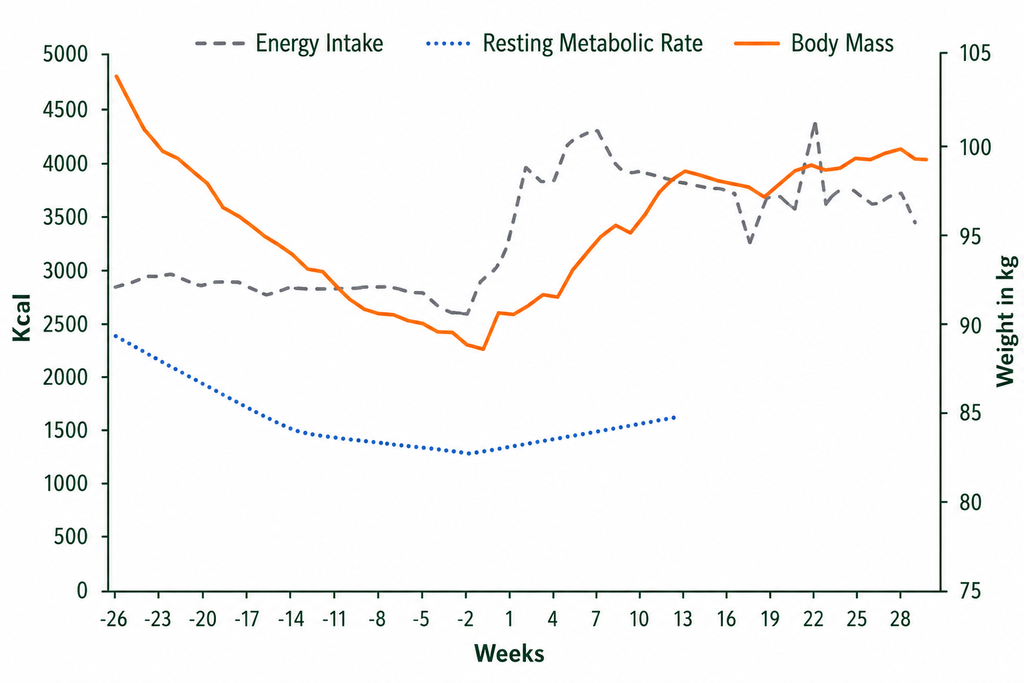
Bodybuilders are a good example of just how significant these metabolic adaptations can be during prolonged periods of dieting. In a 12-month case study of a natural bodybuilder, resting energy expenditure dropped from approximately 2,450 to approximately 1,250–1,300 kcal/day during a 6-month competition diet (1). During that period, the individual lost approximately 14 kg and reduced their body fat percentage from ~15% to 4.5%. But at what cost?
This means that simply by adjusting their RMR (resting metabolic rate), athletes burn more than 1,000 kcal less than they did at the start of the diet phases—every day!
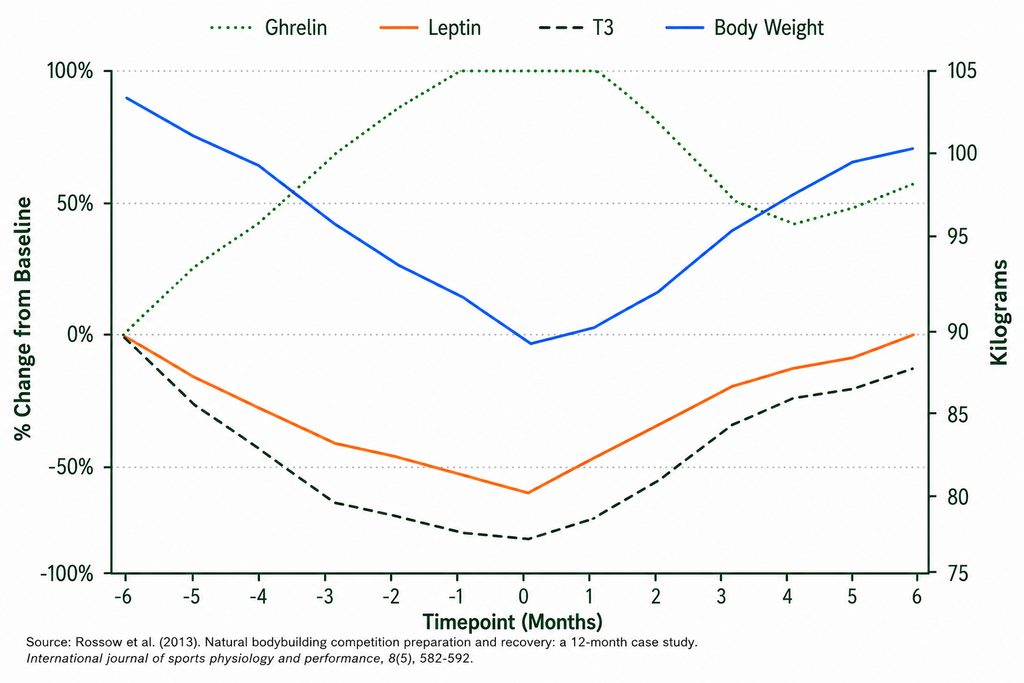
During such a long and extreme period of dieting, many hormones undergo changes. For one thing, the body isn’t getting enough energy, so it can no longer optimally maintain certain important physiological functions. This is evident in a number of ways, among other things.
Leptin—the signal at the heart of the refeed hypothesis
Leptin is released from adipose tissue in proportion to body fat mass and essentially signals to the hypothalamus: “There are sufficient energy reserves.” When body fat mass decreases, leptin levels also decrease. However, a key factor in the physiology of dieting is that during energy restriction, leptin levels often drop disproportionately more than would be explained by fat loss alone, and the brain apparently interprets this drop as a hunger signal, which in turn increases hunger and reduces energy expenditure.
In summary: A certain drop in leptin levels is normal, but a disproportionately large drop can lead to intense cravings.
Perhaps the clearest evidence of this comes from a 1997 study by Weigl and colleagues (2). In 9 obese men, a weight loss of 21.4 ± 3.7% led to a 76.3 ± 8.1% decrease in leptin levels. This decline is significantly greater than what would be expected from fat loss alone. In the same study, leptin changes were also measured in 7 normal-weight women during a 3-day fast. The result was a 61.9 ± 25.2% decrease in leptin. This demonstrates two things: Leptin reacts extremely sensitively to energy availability, not just to fat mass—and this is precisely the physiological mechanism that refeeds are designed to target.
Thyroid Gland: T3 as a Driver of Metabolic Rate
Another key component of basal metabolic rate is the thyroid axis. The thyroid gland primarily produces T4, which must first be converted into the active form, T3, in the liver and muscles. T3 drives mitochondrial activity in virtually every cell and is thus a key regulator of metabolic rate.
An older human study from 1976 demonstrated how sensitive this mechanism is to energy restriction (3). On an 800-kcal diet without carbohydrates (i.e., a very large calorie deficit), serum T3 decreased by 47% within two weeks. In contrast, with the same caloric intake but at least 50 g of carbohydrates per day, T3 and rT3 did not change significantly. The positive effect of carbohydrates on T3 levels is therefore frequently cited as an argument for refeeds with increased carbohydrate intake.
However, another study illustrates even more clearly the relationship between the decline in thyroid hormones and resting metabolic rate: In this intervention study (4), the influence of T3/T4 replacement therapy was deliberately manipulated.
After two weeks of severe calorie restriction, the RMR had fallen to 86% of the baseline value, while T3 had dropped to 72%. T3/T4 replacement therapy was then administered, causing thyroid hormone levels to rise to about 130% of baseline, and lo and behold → RMR recovered to 94%. This suggests that the decline in T3 can indeed contribute to metabolic adaptation—though it is not the sole cause.
NEAT and Movement Efficiency
Another mechanism of metabolic adaptation involves physical activity outside of actual exercise (NEAT). During a diet, energy expenditure may decrease due to a reduction in NEAT, because we unconsciously stand, walk, or move less.
At the same time, however, the energy efficiency of these movements can also change: the muscles then require less energy to perform the same amount of mechanical work. The body becomes more efficient and expends less energy during the same movement. NEAT is therefore not simply a matter of “how much one moves,” but rather results from the amount, type, and energy cost of the movement (5).
For example, following a 10% weight loss, the efficiency of skeletal muscle during low-intensity exercise increased by an average of 26.5% (6). A lower energy expenditure was also observed during walking following significant weight loss, an effect that went beyond what would be expected from the reduced body weight alone (7).
A diet can thus affect energy expenditure on two levels:
- We unconsciously move less
- We can perform the same movement more efficiently at the same time.
The size of each component likely depends on the extent and duration of energy restriction, as well as the type of activity; the available data do not allow for a simple, blanket quantification in this regard.
Sex Hormones
Sex hormones can also respond to prolonged energy restriction. In men , testosterone levels in particular may decline, while in women, weight loss can lead to changes in estradiol, free estradiol, and free testosterone, among other hormones. However, the extent of these changes depends heavily on initial weight, gender, and the severity of the restriction: For example, a meta-analysis found that normal-weight men tended to experience a decrease in testosterone, while overweight men often showed the opposite effect (8). In postmenopausal women, a calorie-restricted diet in a 12-month RCT led, among other things, to a 16.2% decrease in estradiol and a 10.0% decrease in free testosterone (9).
These changes can affect libido, mood, well-being, bone metabolism, and—in the long term—training adaptation and performance. When it comes to energy expenditure, however, sex hormones tend to be an indirect factor: Among other things, they influence the maintenance of muscle and bone mass, but they are not a key regulator of RMR, unlike thyroid hormones, for example.
The adjustments are real, BUT…
When these four mechanisms are considered together, a well-documented physiological picture emerges: During energy restriction, resting energy expenditure, leptin, T3, and possibly also the efficiency of muscle contraction change in a way that makes further weight loss increasingly difficult. It is now well established that these adaptations occur.
However, it remains unclear whether they can actually be effectively prevented or reversed through regular periods of higher energy intake. And even if that is possible, the crucial question remains: Does such a reversal ultimately lead to greater fat loss?
How are refeeds and diet breaks supposed to work anyway?
The theoretical argument can be broken down into two different models.
Refeed
During a refeed, energy restriction is temporarily relaxed—often for one to two days and usually with an emphasis on carbohydrates. The central physiological hypothesis here is leptin: Energy restriction lowers leptin levels, while a short-term increase in energy intake can raise them again. Since leptin is involved in the regulation of hunger and energy homeostasis, this led to the idea that a refeed might also mitigate metabolic adaptations (10).
Diet Break
A diet break continues. Instead of simply eating more for just one or two days, the calorie deficit is suspended for about a week or longer, and energy intake is raised to a maintenance level. The hypothesis is therefore broader: several days at maintenance levels could influence not only leptin but also other adaptations to energy restriction and potentially better preserve resting energy expenditure during the subsequent diet (11).
Both concepts thus have a plausible physiological basis. But plausibility is not yet proof of effectiveness. An increase in leptin or T3 is, at first, merely a biomarker. In practice, what ultimately matters to us is whether this leads to improvements in fat loss, body composition, performance, or the long-term sustainability of a diet.
Refeeds: The Leptin Hypothesis
As mentioned earlier, leptin is an important hormonal signal that, among other things, conveys information about available energy reserves. It serves as a kind of fuel gauge. As the “tank” (body fat) empties, leptin sends a signal to the brain, telling us that we need to conserve our energy reserves → metabolism slows down (metabolic adaptation).
The key question when it comes to refeeds is:
Can we increase leptin levels—primarily through carbohydrates—by intentionally increasing our calorie intake, and thereby have a positive effect on our metabolism?
A refeed can indeed temporarily raise leptin levels that have dropped during a diet. This effect is particularly pronounced when the additional energy comes primarily from carbohydrates. In an RCT study involving lean women, a 3-day carbohydrate-rich diet providing about 40% additional energy resulted in a 28% higher leptin level compared to an isocaloric control group. In contrast, when the additional energy came primarily from fat, leptin levels did not change significantly (12).
This suggests that it is not only the additional energy that is crucial, but also its macronutrient composition. Carbohydrate-rich refeeds can affect leptin regulation more quickly than a comparable fat intake, due to increased glucose and insulin availability as well as changes in carbohydrate oxidation. However, you should not directly apply the 28% figure on a 1:1 basis to your own diet. In the study, participants consumed more calories than their energy requirements, rather than simply raising an existing deficit to maintenance levels. A crucial difference.
Metabolic Reset?
What the study just presented does not answer is how long this increase in leptin lasts and whether it actually results in a relevant physiological benefit. The evidence is significantly weaker in this regard. Here are the details of the only well-conducted study on the topic (13):
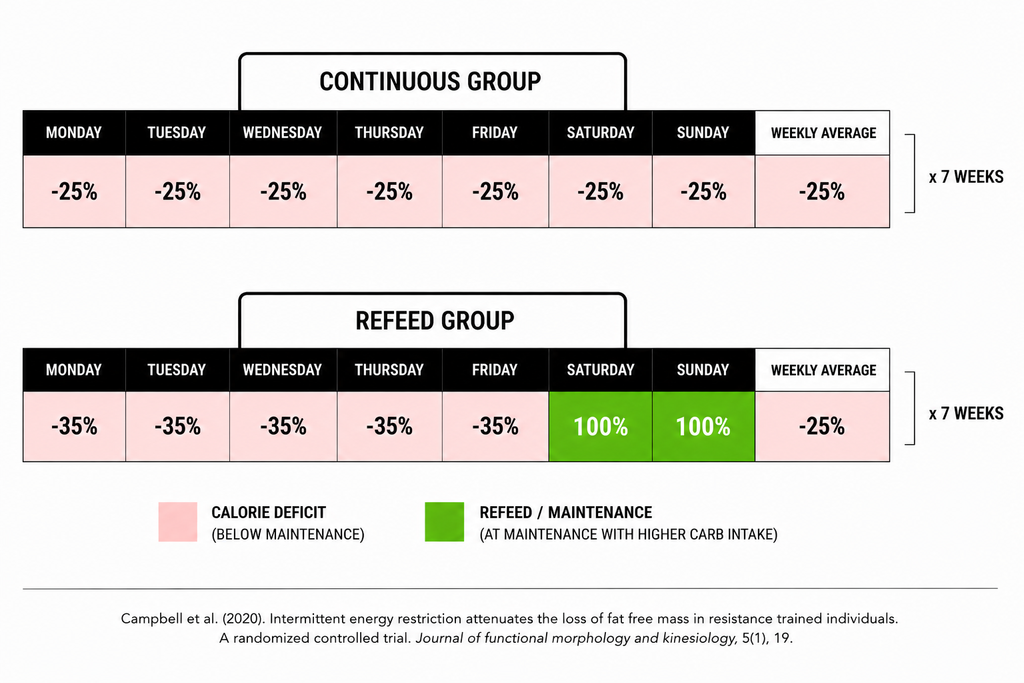
A more interesting question is whether regular refeeds actually prevent metabolic adaptation. In a 7-week RCT study, the following two scenarios were compared:
- A continuous daily deficit of 25%
- A 33% deficit for 5 days + 2 days of refeeding at maintenance calories = an average daily deficit of 25% for one week
The result:
RMR decreased in both groups, though the decrease was slightly smaller in the refeed model than in the continuous deficit model
- RMR decreased by –38 kcal/day in the refeed group
- RMR decreased by –78 kcal/day with continuous restriction
- The difference between the groups was not statistically significant
- There were also minimal benefits in terms of fat-free mass in the “refeed group,” but these, too, were not statistically significant
In practical terms, this means that while a refeed triggers a short-term physiological response, the data available so far do not suggest that two days of eating at maintenance levels permanently reverse the metabolic adaptations resulting from a diet lasting several weeks. From a purely physiological perspective and in terms of fat loss success rates, there is therefore no strong argument for regular refeeds at this time.
Diet Breaks: Can a Longer Break Reduce Metabolic Adaptation?
With diet breaks, the physiological rationale is somewhat more interesting because the interruption in energy restriction lasts significantly longer.
The key question is: If the body responds to a deficit over several weeks, can 1 or 2 weeks at a maintenance level reverse some of that adaptation, and does that subsequently lead to a better result?
The evidence to date has been mixed. Some RCTs show promising indications of reduced metabolic adaptation, while others find no advantage over continuous energy restriction. An important reason for the differing results is the study population: studies involving overweight or obese individuals cannot be readily generalized to lean, strength-trained individuals.
For overweight individuals
In early studies involving predominantly overweight or obese individuals, an intermittent approach showed no clear advantage over continuous restriction in terms of body composition or weight maintenance.
In the study by Arguin et al. (14), a cycle of 5 weeks of restriction followed by 5 weeks of weight stabilization resulted in changes in body weight, fat mass, and resting energy expenditure similar to those observed with continuous restriction. Keogh et al. (15) also found no significant advantage of intermittent restriction over continuous restriction for weight loss, either after 8 weeks or after 12 months.
In contrast, the MATADOR study (16) provided a positive finding: In obese men, alternating between 2 weeks of caloric deficit and 2 weeks of maintenance led to greater weight and fat loss than continuous restriction. The exact reasons why the group with diet breaks (abbreviated as “Inter” in the table) lost more weight/body fat remain unclear. The primary hypothesis is that the regular breaks improved adherence to calorie targets—whereas adherence declined during 4 months of continuous dieting. Participants were provided with most of their meals and also kept daily food diaries. However, whether they actually adhered fully to the prescribed calorie intake was not directly evaluated. Diet adherence was therefore primarily monitored based on changes in body weight.
For strength athletes
For strength trainers—and thus the population of greatest interest to athletes—the evidence is no better. Overall, the available studies show no consistent benefit of diet breaks for fat loss, body composition, or resting metabolic rate. For example, among 38 women who engaged in strength training, no differences in body composition or RMR were observed between a continuous diet and a strategy involving one-week “diet breaks” following two weeks of restriction. It is interesting to note, however, that eating behavior developed more favorably in some respects: The intermittent group showed less disinhibition at the end—that is, a lower tendency toward uncontrolled eating (17).
Similarly, the ICECAP study by Peos et al. (18) found no benefit of the intermittent strategy on fat mass, body weight, fat-free mass, or RMR among 61 adults who engaged in strength training. At the same time, participants who took “diet breaks” reported feeling less hungry and experiencing a higher level of satisfaction. These are certainly important findings that many people overlook in the discussion.
| Study | Population | Intervention | Body Fat / Weight | RMR / Metabolic Adaptation | Distinctive Feature |
|---|---|---|---|---|---|
| Arguin 2012 | 25 women with obesity | 5 weeks of restriction / 5 weeks of stabilization vs. continuous | no clear advantage | no compelling advantage | Early small RCTs |
| MATADOR 2017 | 51 men with obesity | 2 weeks of restriction / 2 weeks of maintenance, 8 restriction blocks | Inter: 14.1 kg vs. Cont: 9.1 kg | Adjusted for lower REE sales at Inter | Inter took 14 weeks longer (30 vs. 16 calendar weeks) |
| Keogh 2014 | Overweight / Obesity | intermittent vs. continuous | comparable | not measured | 12-Month Follow-Up |
| Campbell 2020 | 27 men and women who do strength training | 2 refeed days per week vs. continuous | no significant difference | RMR was descriptively better in the Inter group, but there was no significant group × time effect | |
| Settlers 2023 | 38 women who do strength training | 1-week break after every 2 weeks of dieting | no difference | no difference | Disinhibition improves |
| Peos 2021 | 26 strength-trained athletes | 3 weeks of dieting + 1 week off x 3 | no fat mass effect | RMR ↑ in the short term | Leg endurance improved; maximum strength unchanged; hunger ↓ |
Legend: Cont = continuous energy deficit (a continuous diet with no breaks). Inter = intermittent (refeed days or diet break phases incorporated into the diet).
What We Observe in Practice
In addition to its physiological aspects, a diet break can be particularly interesting from psychological and practical perspectives. During a one-week break, Peos et al. observed, among other things, reduced hunger and irritability, as well as a greater sense of fullness and satisfaction (18). We also observe these effects in practice and therefore make targeted use of diet breaks when the stress of dieting becomes noticeably greater.
That said, a diet break isn’t a mandatory part of every diet. If your hunger, energy levels, workout performance, and adherence remain good, there’s no reason to interrupt your diet just on principle. At the same time, it’s important to remember that every break extends the overall duration of the diet, since fewer days are spent in a caloric deficit during that time. Conversely, a planned phase at maintenance levels with more calories—and especially more carbohydrates—can help improve well-being and workout performance in the short term. Whether and when a diet break makes sense should therefore be decided on an individual basis and adjusted according to the progress of the diet, feelings of hunger, and exercise performance.
We’d be happy to help you optimize your diet, too!!!
✅ Suitable for everyday life
✅ 100% tailored to you, your goals, and your preferences
✅ Based on scientifically validated principles
✅ 100% customized recommendations—no templates or standard plans

⚡ Maximum performance 🔋 Better Recovery 🧠 Better concentration 🦠 Optimized immune system
‼️➡️ Request a free info call for coaching now ⬅️‼️
What does the evidence show overall?
- Idee: Refeeds und Diet Breaks unterbrechen die Energierestriktion kurzfristig, meist durch eine Erhöhung der Energiezufuhr auf Erhaltungsniveau, um physiologische und praktische Nachteile einer längeren Diät abzufedern.
- Hormone: Ein kohlenhydratreicher Refeed kann Leptin kurzfristig erhöhen, während sich hormonelle Anpassungen während längerer Diet Breaks teilweise wieder in Richtung Ausgangswerte bewegen können – ein dauerhafter „Reset“ der hormonellen Regulation ist jedoch nicht belegt.
- RMR: Diet Breaks können den Rückgang des Ruheenergieverbrauchs möglicherweise etwas abschwächen; die Gesamtevidenz zeigt diesen Effekt jedoch vor allem bei Personen mit Übergewicht/Adipositas, während er bei krafttrainierten Personen nicht eindeutig nachweisbar ist.
- Refeeds & Körperkomposition: Für Refeeds gibt es keinen überzeugenden Nachweis, dass sie gegenüber einem kontinuierlichen Kaloriendefizit den Fettverlust oder die Körperzusammensetzung verbessern.
- Diet Breaks – Körperkomposition: Auch Diet Breaks führen nach bisheriger Evidenz nicht zuverlässig zu mehr Fettverlust oder einer besseren Körperzusammensetzung als eine kontinuierliche Diät.
- Diet Breaks – Performance & Wohlbefinden: Gerade bei Athleten können sie aber kurzfristig Hunger und Reizbarkeit reduzieren, das Sättigungsgefühl und Wohlbefinden verbessern und unter Umständen die muskuläre Ausdauerleistung steigern.



0 Comments